
LESSON 03 · Body structure and function
How Cells Use Energy, Move Substances, and Communicate
Cells exchange substances, use energy, and respond to their surroundings. These activities are linked: energy maintains ion differences across membranes, and those differences can help transport nutrients and support electrical signaling. Understanding the connection prepares us to study nerves, muscles, digestion, and metabolism.
What you will be able to do
- Explain how ATP supports cellular work through reaction coupling rather than creating energy.
- Distinguish passive, primary active, and secondary active transport, including the role of electrochemical gradients.
- Describe cellular signaling in terms of reception, intracellular transmission, response, and termination.
In this lesson
How ATP supports cellular workWhere ATP comes fromWhy membranes make transport selectiveHow active transport uses energyHow cells receive and relay signalsWhy a signal must also endBilingual termsSourcesHow ATP supports cellular work
Protein synthesis, contraction, and transport all involve energy transformations. Chemical energy in food does not directly perform every cellular task. A sequence of reactions transfers energy into usable forms. ATP, adenosine triphosphate, is an important participant in that process. Cells continually synthesize and use it; ATP is not the body's long-term store of all its available energy.
Under cellular conditions, the overall hydrolysis of ATP to products including ADP and inorganic phosphate can release free energy—the energy available to do work under those conditions. Enzymes couple this process to reactions such as synthesis or transport that would otherwise be unfavorable. It is misleading to say that simply breaking a chemical bond produces energy. Breaking a bond requires energy; the net free-energy change depends on the complete transformation of reactants into products. ATP does not create energy. It helps cells transform and use energy obtained from sources such as nutrients, with some energy ultimately dissipated as heat.
Where ATP comes from
Glycolysis takes place in the cytoplasm. It produces a small amount of ATP while converting glucose into products including pyruvate. In cells with mitochondria, under suitable conditions, subsequent pathways allow more of the energy from nutrients to support ATP production. Glycolysis does not directly require oxygen, so lack of oxygen does not mean that all ATP production immediately becomes impossible. Different pathways nevertheless differ in their capacity and sustainability.
Electron transfer at the inner mitochondrial membrane helps establish an electrochemical difference for hydrogen ions across the membrane. Their return through ATP synthase can drive ATP formation. Oxygen accepts electrons at the end of the electron transport chain and contributes to water formation. Oxygen delivery, circulation, intact membranes, and cellular metabolism are therefore connected. Cells do not all use an identical arrangement: mature red blood cells lack mitochondria and obtain ATP mainly through glycolysis.
Explore the concept
| Process | Key question | Distinction |
|---|---|---|
| Passive transport | Can the substance move down its concentration or electrochemical gradient? | Membrane proteins may still be required |
| Active transport | How is energy used to move against a gradient? | Energy may come from ATP or another gradient |
| Signalling | How does a receptor produce a cellular response? | The signal molecule need not enter the cell |
Why membranes make transport selective
A membrane's lipid bilayer is more permeable to some substances than others. Some small uncharged molecules cross relatively readily, whereas ions and many larger polar molecules require membrane proteins. In passive transport, a substance moves down its concentration or electrochemical gradient without direct ATP expenditure by that transport process. Facilitated diffusion through a channel or carrier can still be passive. Protein involvement does not, by itself, make transport active.
For an uncharged substance, concentration difference is an important determinant of net movement. For an ion, electrical forces also matter. The combined chemical and electrical influence is the electrochemical gradient. Its components can reinforce each other or favor opposing directions. Net water movement across a selectively permeable membrane involves osmosis. Cell volume therefore depends not simply on the presence of water, but on solute distribution and which substances the membrane allows to cross.
How active transport uses energy
Active transport moves a substance against its concentration or electrochemical gradient and requires an energy source. Primary active transport couples movement directly to a process such as ATP hydrolysis. A typical sodium–potassium pump cycle moves three sodium ions out of a cell and two potassium ions in. This helps maintain unequal ion distributions across the membrane, one of the conditions supporting electrical activity.
Secondary active transport uses energy available when another substance moves down its gradient. In one intestinal absorption mechanism, sodium entry is coupled to glucose entry, allowing glucose to move against its own concentration gradient. The cotransporter does not directly split ATP. It nevertheless depends on sodium–potassium pumps elsewhere in the membrane to maintain the sodium gradient. No direct ATP use at one step does not mean that the overall process is independent of metabolism. Following the energy source requires considering the connected transport processes.
How cells receive and relay signals
A signaling molecule arriving near a cell does not make every cell respond identically. The cell needs an appropriate receptor and the machinery that produces a response. Some receptors are in the cell membrane, while others are intracellular. Whether a signaling molecule can cross the membrane helps determine how it acts. Reception may lead to changes in enzyme activity, ion-channel behavior, or gene expression.
Many pathways involve successive changes in proteins. Protein kinases add phosphate groups to particular proteins, whereas phosphatases remove them. These modifications can alter activity, but phosphorylation does not universally mean switching a protein on. Small intracellular molecules or ions can also serve as second messengers. A receptor event may affect many downstream molecules, amplifying the signal. The resulting response depends on the internal network as well as the incoming signal, so external concentration alone cannot describe the entire cellular outcome.
Why a signal must also end
A signaling process includes termination and adjustment as well as reception and response. A signaling molecule may be removed, receptors may change state, second messengers may be broken down or redistributed, and protein modifications may be reversed. A diagram that only shows increasing activation cannot explain how a cell becomes ready for a later signal. With sustained stimulation, responsiveness may also decrease. Signal amount and final effect are therefore not always proportional.
Energy, transport, and signaling meet here. Changing ion distributions requires membrane proteins and energy; changes in ions can convey signals; signals can regulate transport proteins and metabolic enzymes. We study these processes separately to clarify their mechanisms, although they interact in living cells. When a claim promises to activate cells or boost cellular energy, ask what specific process changed, in which cells and circumstances, and whether the evidence supports the claimed effect in people.
Apply what you have learned
An intestinal glucose cotransporter does not directly hydrolyze ATP. Why can absorption through it still be affected if the sodium–potassium pump maintaining the sodium gradient stops? Explain in the order of energy supply, ion gradient, and cotransport.
Read the explanation
The pump uses ATP to help maintain a low intracellular sodium concentration. If it stops while other transport continues, the sodium electrochemical gradient can progressively change. Less driving force may then be available for sodium entry and the glucose transport coupled to it. The effect need not be complete or instantaneous; it depends on existing gradients and other processes. This illustrates the indirect energy dependence of secondary active transport.
Bilingual terms
- 反应耦联 · reaction coupling
- Linking an energetically favorable process to one that requires an energy input.
- 电化学梯度 · electrochemical gradient
- The combined chemical and electrical influence on the movement of an ion.
- 受体 · receptor
- A molecule, usually a protein, that recognizes a signal and participates in initiating a cellular response.
Sources and further reading
- OpenStax Biology 2e: ATP
- OpenStax: Glycolysis
- OpenStax: Oxidative Phosphorylation
- OpenStax: Passive Transport
- OpenStax: Active Transport
- OpenStax: Signaling Molecules and Cellular Receptors
- OpenStax: Propagation of the Signal
- OpenStax: Response to the Signal
Original course source-check record: 9 September 2026. Full Chinese and English sentence-by-sentence language review: 14 September 2026. AI editing and language review are not human clinical review. Linked institutions have not participated in or endorsed this course.
A moment in nature
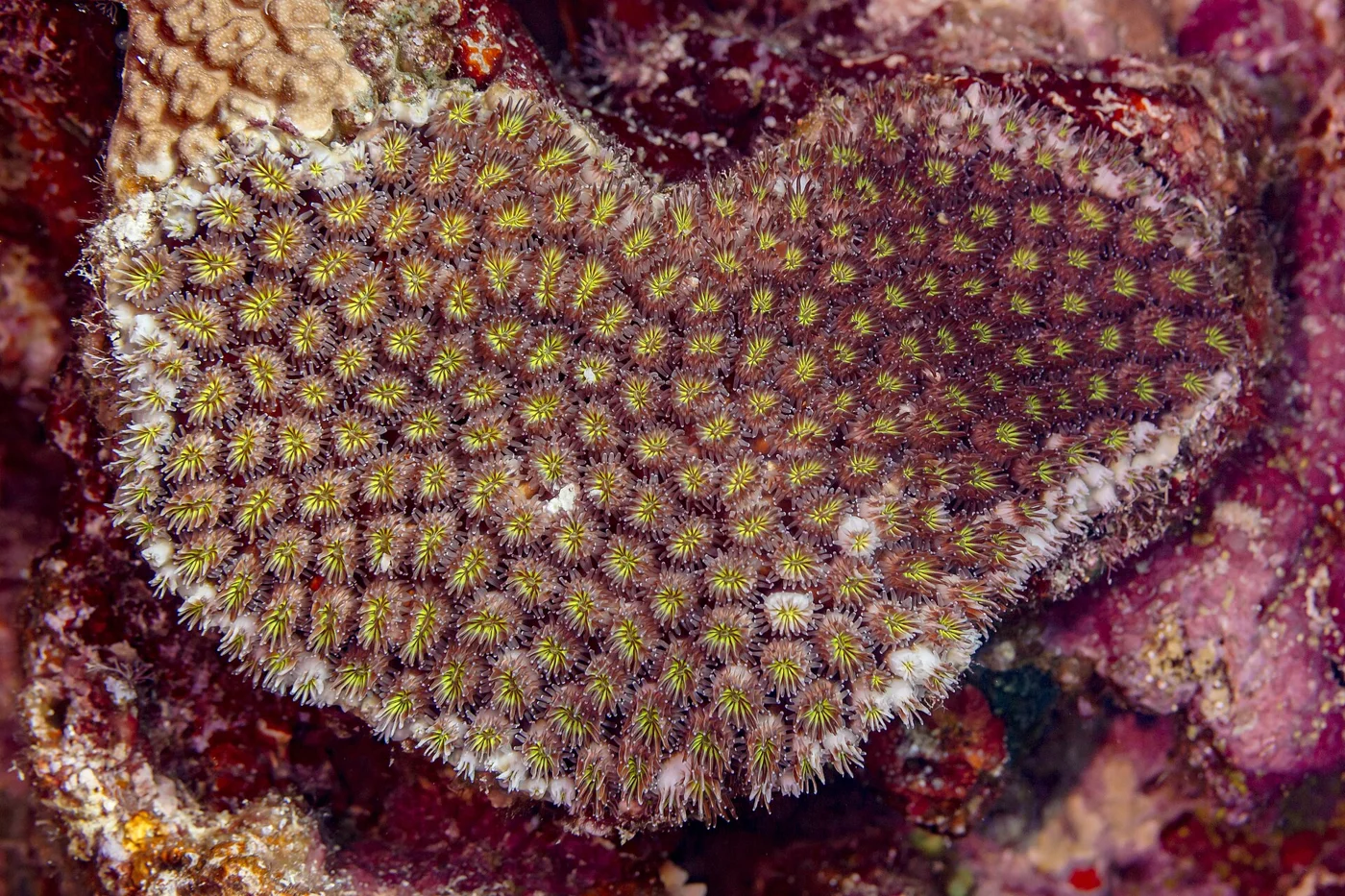
Coral (Galaxea fascicularis), mar Rojo, Egipto, 2023-04-18, DD 128.jpg · Diego Delso · CC BY-SA 4.0
Converted to WebP; thumbnails may be cropped.
,_mar_Rojo,_Egipto,_2023-04-18,_DD_128.jpg)