
LESSON 22 · Body structure and function
Systems working together: exercise, meals and heat
Exercise, meals and heat change the tasks of several systems at once. Integration depends on material and energy balances, feedback timing and allocation of shared resources.
What you will be able to do
- Trace fuel, oxygen and heat during exercise.
- Trace nutrient absorption, transport and storage after a meal.
- Analyse shared resources and different regulatory timescales.
In this lesson
How body systems work together to maintain stable conditionsExercise connects muscle demand with breathing and circulationA meal requires digestion, transport and storage to cooperateHeat challenges cooling and circulation togetherRapid responses and slower adjustments are not interchangeableTest integration with a combined scenarioBilingual termsSourcesHow body systems work together to maintain stable conditions
Body systems do not each maximise output. They jointly maintain conditions suitable for cellular function. Variables such as glucose availability, oxygen delivery, temperature and extracellular fluid volume are regulated through different sensors, signals and effectors. Homeostasis is dynamic stability supported by ongoing balances, not an absolutely unchanging number. A higher heart rate during exercise can be adaptive rather than evidence of failure merely because it differs from rest. OpenStax A&P: cardiac physiology; OpenStax A&P: metabolic states of the body
Begin an analysis by specifying the quantity and timescale: oxygen delivered each minute, water lost over hours or stored energy changing over days. Inputs minus outputs help predict storage changes, but multiple compartments and conversions prevent one blood concentration from representing every reserve. Then trace which system detects the disturbance, which acts and whether its response can compensate in time. This makes organ knowledge a tool for explaining whole-body behaviour rather than a list of separate structures. OpenStax A&P: metabolic states of the body; OpenStax A&P: energy and heat balance; OpenStax A&P: endocrine regulation of kidney function
Exercise connects muscle demand with breathing and circulation
Muscle contraction consumes ATP, replenished through pathways involving phosphocreatine, carbohydrate and fat, with contributions changing by intensity and duration. Greater metabolism can increase oxygen requirements, carbon dioxide generation and heat production. Cardiac output adjusts through heart rate and stroke volume, while regional vascular changes direct more blood toward active muscle. This does not mean maximally opening every vascular bed at once. OpenStax A&P: cardiac physiology; OpenStax A&P: muscle fiber contraction and relaxation
Increased ventilation helps match carbon dioxide production and exchange and is influenced by neural commands and chemical feedback. Breathing and heart rate can change rapidly at exercise onset, showing that regulation need not wait until oxygen is exhausted. Performance also depends on haemoglobin, lung exchange, microcirculation and cellular use. Equal heart rates do not establish equal exercise intensity because stroke volume, fitness, efficiency and external load differ. Record the task’s speed or resistance separately from the person’s physiological response. OpenStax A&P: modifications in respiratory functions; OpenStax A&P: cardiac physiology
System roles within shared events
| Event | Main task | Cooperating processes |
|---|---|---|
| Exercise | Meet muscle energy demand | Circulation, breathing, metabolism |
| Meal | Process and store nutrients | Gut, liver, endocrine signals |
| Heat | Limit heat storage | Skin, circulation, fluid regulation |
| Recovery | Handle residual heat and metabolic needs | Continued ventilatory and circulatory adjustment |
Pulmonary, systemic and hepatic portal circulation
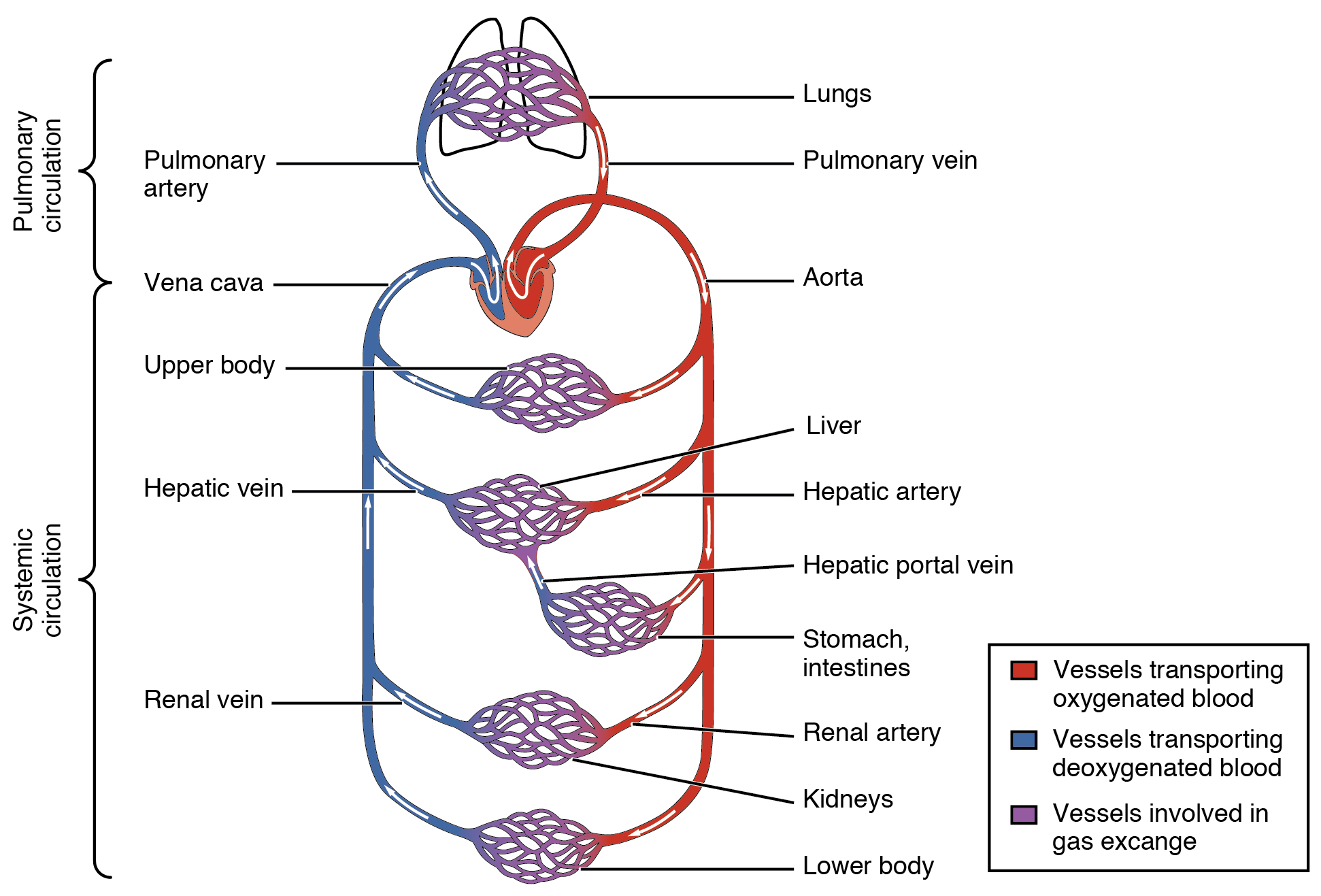
Pulmonary, systemic and hepatic portal circulation · OpenStax College · CC BY 3.0

| English label | Chinese equivalent |
|---|---|
| Pulmonary artery | 肺动脉 |
| Pulmonary vein | 肺静脉 |
| Aorta | 主动脉 |
| Vena cava | 腔静脉 |
| Hepatic portal vein | 肝门静脉 |
A meal requires digestion, transport and storage to cooperate
After food enters the gut, movement and secretion progressively process large molecules. Absorption products enter blood or lymph. Many water-soluble nutrients reach the liver through portal blood, whereas long-chain lipids mainly enter lymph in chylomicrons. Intestine, pancreas, liver and circulation perform different steps in the same event. The end of swallowing is not the end of nutrient processing. OpenStax A&P: digestive system processes and regulation; OpenStax A&P: chemical digestion and absorption a closer look
Signals including insulin favour uptake and storage. Liver and muscle store glycogen, and adipose tissue participates in lipid storage. Tissues respond differently rather than every cell being controlled identically by one hormone. Gastric emptying and intestinal feedback also regulate delivery. Meals with equal energy but different composition, structure and eating speed can produce different absorption patterns and fullness. This respects energy conservation while showing that a total does not describe timing. Ask how much enters, when, where it goes and whether it is used or stored. OpenStax A&P: metabolic states of the body; OpenStax A&P: digestive system processes and regulation
Heat challenges cooling and circulation together
In heat, increased skin blood flow carries heat toward the surface, while sweat evaporation provides cooling. During simultaneous exercise, muscle also demands greater perfusion, requiring cardiovascular coordination. Humidity, airflow, clothing and solar radiation alter heat exchange, so equal outdoor temperatures need not represent equal thermal loads. Net heat gain or loss determines the direction of heat storage. OpenStax A&P: energy and heat balance; OpenStax A&P: cardiac physiology
Sweating removes body fluid and can reduce circulatory filling. Renal and hormonal responses, including reduced water excretion, support balance but cannot instantly replace water already lost. A faster heart rate can help compensate, but it cannot fully offset every reduction in blood volume and stroke volume. The same walking speed can therefore impose different internal demands in cool versus humid hot conditions. These are allocation and capacity limits, not failures of personal willpower. Monitoring sweat or pulse alone omits parts of the system, making environmental information essential to physiological interpretation. OpenStax A&P: endocrine regulation of kidney function; OpenStax A&P: cardiac physiology
Rapid responses and slower adjustments are not interchangeable
Neural signals can rapidly alter heart rate, vascular tone and ventilation. Hormonal effects, renal water and salt handling and tissue metabolic adjustments operate over different intervals. Some hormones act quickly while other consequences require transcription and protein changes, so neural versus endocrine is not a perfectly fast-versus-slow division. Ask whether a measurement captures onset, transition or an approach to a new balance. OpenStax A&P: cardiac physiology; OpenStax A&P: modifications in respiratory functions; OpenStax A&P: endocrine regulation of kidney function
After exercise stops, external work falls while temperature, breathing and pulse may remain elevated. Previously generated heat and ongoing metabolic processes still require handling, and circulation is being redistributed. Absorption continues after eating ends, and renal water output need not immediately match a drink. These delays reflect dynamic regulation rather than automatically proving disease. Conversely, ongoing compensation does not establish that the disturbance has been removed: maintaining one variable may require prolonged changes elsewhere that carry a physiological cost. A time series often explains these adjustments better than selecting one maximum or minimum. OpenStax A&P: modifications in respiratory functions; OpenStax A&P: metabolic states of the body; OpenStax A&P: energy and heat balance
Test integration with a combined scenario
Imagine brisk walking after lunch in hot humid conditions. Absorption, exercise metabolism and heat removal occur together rather than as three independent programmes. List the material and heat transfers involved, then identify shared resources such as blood flow, body fluid and metabolic substrates. Multiple adjustments coordinate the tasks, but ordinary adaptability does not imply unlimited capacity at every intensity and duration. OpenStax A&P: cardiac physiology; OpenStax A&P: metabolic states of the body; OpenStax A&P: energy and heat balance
Treat a higher-than-usual pulse as an observation rather than a diagnosis. Candidate explanations include pace, heat load, fluid state, anxiety and other bodily conditions. Compare environmental, activity and timing information to distinguish them. A pulse alone does not reveal stroke volume, temperature or electrolyte state. A systems model identifies these information gaps and links hypotheses to observable variables. The conclusion should state what current evidence supports, without turning one plausible mechanism into an already established complete account of a real person. OpenStax A&P: cardiac physiology; OpenStax A&P: modifications in respiratory functions; OpenStax A&P: endocrine regulation of kidney function
Apply what you have learned
Do equal walking speed and heart rate establish equal physiological demand across two occasions?
Read the explanation
No. Environment, stroke volume, temperature, fluid balance, efficiency and timing may differ. The external task and a few readings do not describe the complete system.
Bilingual terms
- 稳态 · Homeostasis
- Relative internal stability maintained through ongoing regulation.
- 效应器 · Effector
- A tissue or organ executing a regulatory response.
- 心输出量 · Cardiac output
- Blood volume pumped by one ventricle per minute.
- 热平衡 · Heat balance
- The balance of heat production and gain against loss.
- 代谢底物 · Metabolic substrate
- Material available for metabolic reactions.
Sources and further reading
- OpenStax A&P: cardiac physiology
- OpenStax A&P: modifications in respiratory functions
- OpenStax A&P: metabolic states of the body
- OpenStax A&P: energy and heat balance
- OpenStax A&P: endocrine regulation of kidney function
- OpenStax A&P: muscle fiber contraction and relaxation
- OpenStax A&P: digestive system processes and regulation
- OpenStax A&P: chemical digestion and absorption a closer look
Original course source-check record: 9 September 2026. Full Chinese and English sentence-by-sentence language review: 14 September 2026. AI editing and language review are not human clinical review. Linked institutions have not participated in or endorsed this course.
A moment in nature
Common kingfisher on a branch opening its wings.jpg · Alexis LOURS · CC BY 2.0
Converted to WebP; thumbnails may be cropped.
