
LESSON 60 · Growth, development and ageing
Embryonic and fetal development
Prenatal development combines differentiation, organ formation, and maternal–fetal exchange. Gestational age, placental function, and test evidence describe different aspects of that process.
What you will be able to do
- Distinguish gestational age from age after fertilization.
- Explain placental exchange and fetal circulation.
- Interpret the limits of prenatal tests and exposure information.
In this lesson
Gestational age and time since fertilizationThe placenta is a developing exchange organPlacental oxygenation requires a different circulationFormation, growth, and maturation differExposure risk depends on substance, dose, and timingPrenatal care integrates several kinds of evidenceBilingual termsSourcesGestational age and time since fertilization
Clinical gestational age is usually counted from the first day of the last menstrual period rather than fertilization. In a typical example it is about two weeks greater than postfertilization age, but variable ovulation changes that relationship. Early ultrasound and history help establish an appropriate estimate. A textbook’s eighth week after fertilization therefore differs from a report’s eighth gestational week. Always identify the convention before interpreting developmental timing. After fertilization, the zygote divides, implantation occurs, and cells acquire different functions as structures emerge. The embryonic period generally covers the first eight postfertilization weeks, followed by the fetal period, emphasizing growth and further maturation—approximately after ten gestational weeks. This does not mean no growth occurred earlier or no differentiation continues later. More cells and a fully functional organ are different achievements.
Sources: MedlinePlus: Fetal development.
The placenta is a developing exchange organ
Placental development involves embryo-associated cells establishing connections with the uterine lining, with villous structures and maternal vessels changing to support exchange. Remodelling of uterine spiral arteries helps adapt blood supply. The placenta is not a finished filter present immediately after conception; it is a developing organ with transport, endocrine, and immune-related functions. Maternal and fetal circulations interact without becoming one freely mixed pool. Oxygen, nutrients, and metabolic products cross an exchange interface whose performance depends on blood flow, surface area, barrier properties, and transport mechanisms. Selectivity does not block every medicine, alcohol exposure, or pathogen. Abnormal supply or transport can affect growth, explaining why eating more cannot solve every case of a small fetus. Interpretation must separate nutrition, placental performance, fetal factors, and gestational-age estimation rather than relying on weight alone.
Sources: NICHD: Placental development.
Important connections in fetal circulation
| Structure | Direction or connection | Significance |
|---|---|---|
| Umbilical vein | Placenta toward fetus | Relatively oxygen-rich blood |
| Umbilical arteries | Fetus toward placenta | Return to exchange interface |
| Foramen ovale | Right atrium to left atrium | Bypasses lungs for part of flow |
| Ductus arteriosus | Pulmonary artery to aorta | Bypasses lungs for part of flow |
Placenta and fetal circulatory shunts
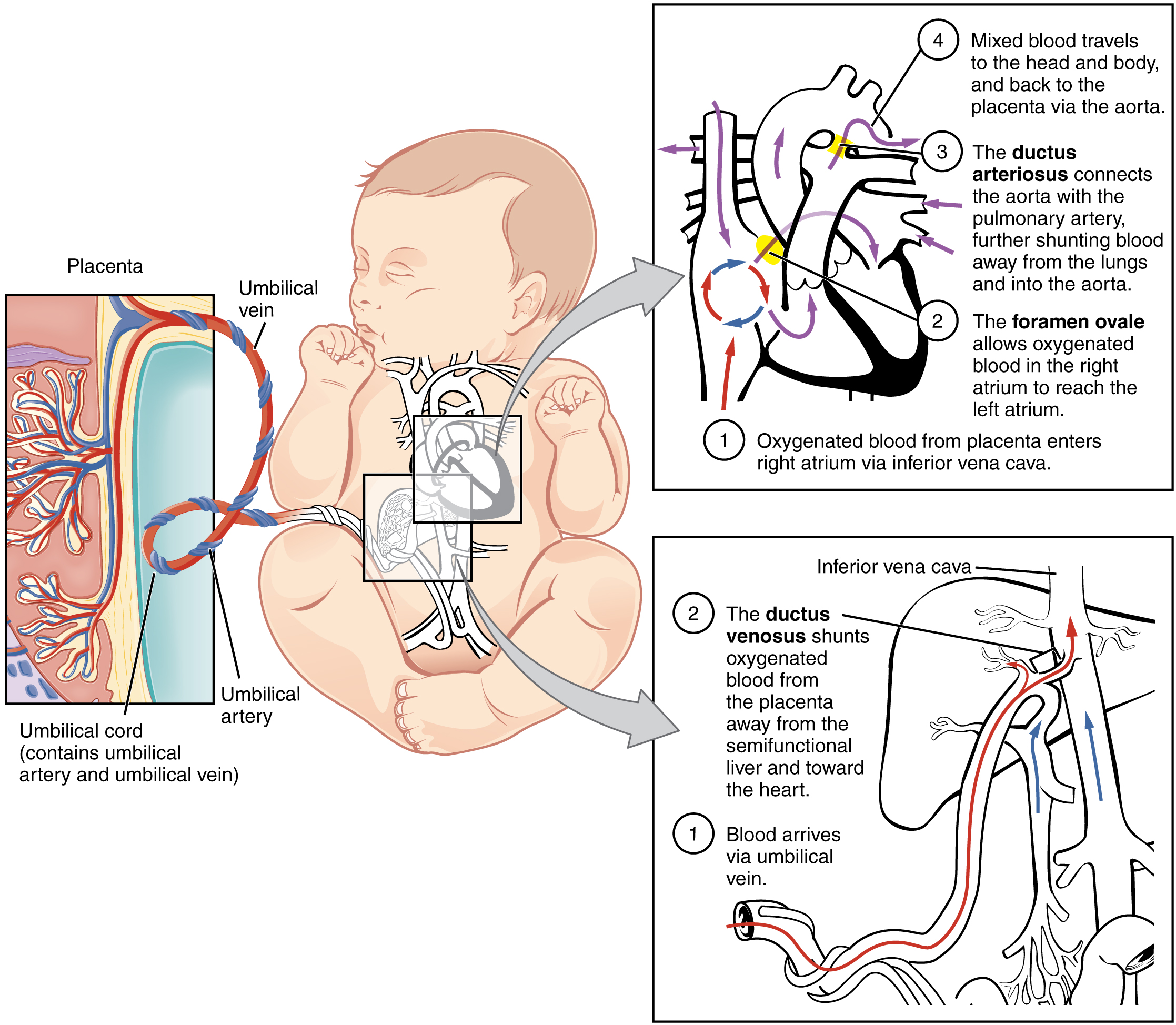
Placenta and fetal circulatory shunts · OpenStax College · CC BY 3.0

| English label | Chinese equivalent |
|---|---|
| Placenta | 胎盘 |
| Umbilical vein | 脐静脉 |
| Umbilical artery | 脐动脉 |
| Foramen ovale | 卵圆孔 |
| Ductus arteriosus | 动脉导管 |
| Ductus venosus | 静脉导管 |
Placental oxygenation requires a different circulation
The fetal lungs do not yet perform postnatal gas exchange; oxygen comes primarily through the placenta. The umbilical vein carries relatively oxygen-rich blood toward the fetus, while umbilical arteries return blood to the placenta. Vessels are named by direction of flow, not an absolute rule that arteries carry more oxygen. Some umbilical venous blood passes through the ductus venosus, bypassing part of the hepatic circulation. The foramen ovale and ductus arteriosus allow substantial blood flow to bypass the lungs. These pathways have normal functions before birth. Lung expansion and changing resistance and pressure relationships subsequently shift circulation toward the newborn pattern. A structure can therefore mean different things at different ages; an opening or duct should not automatically be interpreted through adult disease concepts. This also helps explain changing manifestations of some congenital heart conditions after birth.
Formation, growth, and maturation differ
Early development establishes basic organ form, followed by continued proliferation, connections, and functional maturation. Increasing size later in pregnancy does not make the brain, lungs, or other systems identical to those of a full-term newborn. Movement also does not prove completion of every neurological function. Development depends on gestational age, genetics, placenta, and maternal conditions, with normal variation; fruit-size analogies cannot assess health. Prenatal observation considers growth over time relative to gestational age and other evidence. A small measurement may reflect dating, measurement error, constitutional differences, or growth restriction, requiring different interpretations. Prematurity is likewise more than low weight: two equally heavy newborns may differ in organ maturity because they were born at different gestational ages. Decisions about earlier delivery balance continuing-pregnancy risks against postnatal risks instead of mechanically pursuing a target weight.
Sources: MedlinePlus: Fetal development; NICHD: Pregnancy.
Exposure risk depends on substance, dose, and timing
Developing tissues differ in susceptibility across stages, and risk also depends on substance, dose, duration, and individual conditions. Having encountered something during pregnancy is therefore an incomplete exposure description: it neither guarantees safety nor establishes injury. There is no known safe amount or safe period for alcohol use in pregnancy. Stopping and obtaining support is useful, but this preventive advice does not predict an individual fetus’s outcome from one previous exposure. Medicine decisions must weigh treated and untreated disease, avoiding abrupt self-discontinuation of long-term prescriptions. Infection prevention, food safety, vaccination, and occupational exposure assessment also require context. Lin worries about a cold medicine taken before recognizing pregnancy. Recording the product, dose, and timing for professional review is more useful than searching only for a blanket pregnancy prohibition. Specific information enables an evidence-based assessment rather than diffuse fear.
Sources: CDC: Alcohol during pregnancy; NICHD: Prenatal care; CDC: During pregnancy.
Prenatal care integrates several kinds of evidence
Prenatal care considers maternal blood pressure, illness, nutrition, mood, and circumstances alongside fetal health. Ultrasound provides selected structural and growth information; screening estimates selected risks; diagnostic procedures answer more specific questions. Noninvasive prenatal screening analyzes cell-free DNA in maternal blood, including placental contributions. It is screening, not definitive testing for every genetic disorder. Increased-risk results usually require counselling and diagnostic confirmation, while reduced-risk results cannot exclude every structural or functional problem. If Lin has a slightly small ultrasound measurement and low-risk screening, the latter does not invalidate the former or combine into one overall passing score. Ask what each test measured, consider dating and trends, and follow the clinical plan. Severe persistent headache, visual changes, chest pain or breathing difficulty, significant bleeding, or markedly reduced established fetal movement require immediate contact with the clinical team or emergency services rather than waiting for a routine visit.
Sources: NICHD: Prenatal care; MedlinePlus Genetics: NIPT; CDC: Urgent maternal warning signs.
Apply what you have learned
Why is the relatively oxygen-rich umbilical vessel called a vein?
Read the explanation
Veins carry blood toward the heart and arteries away from it; oxygen content depends on where exchange occurs. Placental oxygenation makes the umbilical pattern differ from adult systemic circulation.
Bilingual terms
- 孕周 · Gestational age
- Pregnancy age usually dated from the first day of the last menstrual period.
- 着床 · Implantation
- Establishment of the early embryo within the uterine lining.
- 胎盘 · Placenta
- A temporary organ supporting exchange and endocrine functions.
- 卵圆孔 · Foramen ovale
- A normal fetal connection between the atria.
- 产前筛查 · Prenatal screening
- Testing that estimates risk of selected fetal conditions.
Sources and further reading
- MedlinePlus: Fetal development
- NICHD: Placental development
- American Heart Association: Fetal circulation
- NICHD: Pregnancy
- CDC: Alcohol during pregnancy
- NICHD: Prenatal care
- MedlinePlus Genetics: NIPT
- CDC: Urgent maternal warning signs
- CDC: During pregnancy
Original course source-check record: 9 September 2026. Full Chinese and English sentence-by-sentence language review: 14 September 2026. AI editing and language review are not human clinical review. Linked institutions have not participated in or endorsed this course.
A moment in nature

Peacock butterfly (Aglais io) 2.jpg · Charles J. Sharp · CC BY-SA 3.0
Converted to WebP; thumbnails may be cropped.
_2.jpg)