
LESSON 62 · Growth, development and ageing
How newborns adapt after birth
Birth coordinates several transitions: lungs take over gas exchange, circulation is redirected, and continuous placental support ends. Their connections explain why observation, feeding assessment, and screening occur together.
What you will be able to do
- Explain pulmonary and systemic circulatory transition.
- Connect temperature, glucose, intake, and jaundice.
- Distinguish screening, diagnosis, and emergency recognition.
In this lesson
Circulatory reorganization behind the first breathsThermal care reduces metabolic demandsFrom continuous supply to intermittent feedingJaundice depends on production, clearance, and timingScreening looks for clues before symptomsRecognizing urgency does not require naming the diseaseBilingual termsSourcesCirculatory reorganization behind the first breaths
Fetal lungs contain fluid, while the placenta provides gas exchange and the umbilical vein carries oxygenated blood toward the fetus. At birth, lung fluid clearance, inflation, and effective ventilation develop together. Pulmonary vascular resistance falls, allowing more blood to pass through the lungs. Interruption of placental circulation also changes systemic resistance. Breathing and circulation must therefore adapt as a coordinated system. The foramen ovale and ductus arteriosus previously allowed much of the blood to bypass the lungs. Changes in pressure and oxygen after birth alter these pathways, but functional closure and permanent anatomical closure are not simultaneous events. Cutting the cord does not instantly erase every fetal connection. This distinction helps explain why some congenital heart problems become apparent after an initially reassuring period as circulatory pathways change. Continued observation after discharge has a physiological purpose, rather than simply repeating the examination performed at birth.
Sources: MedlinePlus: Changes in the newborn at birth; AHA: Fetal circulation.
Thermal care reduces metabolic demands
Newborns have a large surface area relative to body mass, and wet skin loses heat through evaporation. Preterm infants have additional limitations in skin integrity, fat reserves, and regulation. Brown fat can generate heat without ordinary shivering, but doing so consumes energy and oxygen. Thermal stress can therefore interact with respiratory and glucose difficulties. Drying, appropriate warmth, and observation after delivery support metabolism as well as comfort. The aim is a suitable body temperature, not sweating under progressively thicker layers. At home, electric blankets and soft bulky bedding are not substitutes for safe sleeping arrangements. Consider a baby who becomes unusually quiet after a bath while still wet. Quietness alone does not establish comfort: temperature, responsiveness, feeding, and breathing must be considered together. Marked hypothermia or difficulty waking requires immediate medical attention, not simply more wrapping and a prolonged period of waiting to see whether the baby improves.
Sources: StatPearls: Physiology, Neonatal; NHS: Urgent medical help for babies and children under 5.
Postnatal transitions and their observation
| Transition | Physiology | Observation |
|---|---|---|
| Respiration and circulation | Lung aeration and increased pulmonary flow | Breathing effort and colour |
| Temperature | Heat loss and production rebalance | Temperature and responsiveness |
| Energy supply | Placental supply replaced by feeding and regulation | Effective swallowing, urine, and weight |
| Bilirubin | Production may exceed clearance | Age in hours, measurement, and trend |
Placenta and fetal circulatory shunts
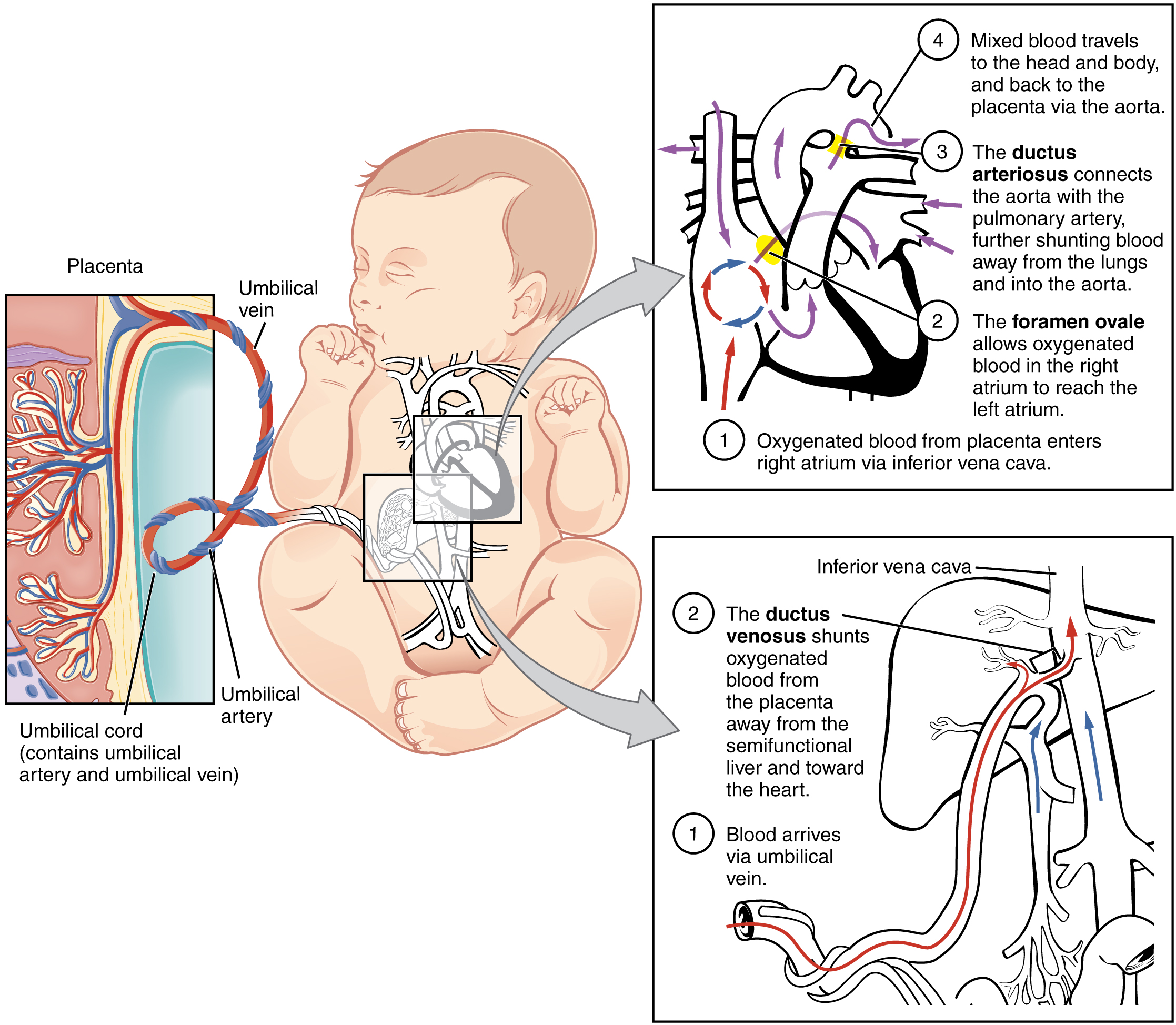
Placenta and fetal circulatory shunts · OpenStax College · CC BY 3.0

| English label | Chinese equivalent |
|---|---|
| Placenta | 胎盘 |
| Umbilical vein | 脐静脉 |
| Umbilical artery | 脐动脉 |
| Foramen ovale | 卵圆孔 |
| Ductus arteriosus | 动脉导管 |
| Ductus venosus | 静脉导管 |
From continuous supply to intermittent feeding
When placental glucose delivery ends, newborns must mobilize glycogen, establish endogenous glucose production, and obtain energy from feeds. This transition takes time. Prematurity, unusual growth patterns, and particular maternal or infant conditions can change risk, which is why clinicians monitor glucose in selected babies. Adult fasting glucose rules cannot simply be transferred to newborns, and one episode of trembling or quietness cannot establish hypoglycaemia at home. Effective feeding requires coordination of sucking, swallowing, and breathing. Time spent attached to a breast or bottle is not equivalent to milk transferred. Assessment combines feeding behaviour, urine and stool patterns, weight trajectory, and responsiveness. Imagine two babies each feeding for twenty minutes. One swallows regularly and begins recovering weight; the other repeatedly falls asleep and produces less urine. The same duration describes different physiological outcomes. The second baby needs timely feeding and health assessment, rather than a demand that the family merely try harder.
Sources: StatPearls: Neonatal hypoglycemia; MedlinePlus: Changes in the newborn at birth.
Jaundice depends on production, clearance, and timing
Bilirubin is produced during haem breakdown. Red-cell turnover, hepatic processing, and intestinal elimination jointly determine its concentration. Inadequate intake can delay stool passage and increase intestinal reabsorption, linking jaundice assessment with feeding assessment. This does not mean that all jaundice indicates harmful breast milk. Most jaundiced babies can continue breastfeeding; additional feeds, phototherapy, or other treatment depend on the individual assessment. Visible skin colour cannot reliably replace bilirubin measurement, and a photograph is not a laboratory result. Age in hours, gestational age, concentration trends, and additional risks change interpretation, so the same number can mean different things in different babies. Jaundice in the first day, worsening yellowing, or jaundice with poor feeding or reduced responsiveness needs prompt assessment. Sunlight is not a substitute for prescribed treatment. Clinical phototherapy uses controlled light exposure to alter bilirubin and includes monitoring, making it fundamentally different from placing a baby near a window.
Sources: CDC: Jaundice and breastfeeding; StatPearls: Neonatal jaundice.
Screening looks for clues before symptoms
Newborn screening matters because some serious, treatable conditions have no obvious outward signs at birth. Blood-spot testing, hearing screening, and pulse oximetry look for different clues, and programmes differ across regions. Pulse oximetry helps identify risk of certain critical congenital heart defects but cannot exclude every cardiac abnormality. A hearing screen that is not passed may reflect a temporary factor, yet still requires the planned repeat or diagnostic assessment. An abnormal screen indicates a need for confirmation, not an established diagnosis. Passing a screen also does not make later symptoms irrelevant. Families should know who communicates results, when to ask about them, and whether another sample is required. Not receiving a telephone call does not prove that the result is normal. If a healthy-looking baby receives a recall, the useful response is timely follow-up and reliable contact details. Screening produces benefit only when detection connects to interpretation, diagnosis, and effective intervention.
Sources: HRSA: Newborn screening process.
Recognizing urgency does not require naming the disease
Newborn immune function and organ regulation are still developing. Serious illness may first appear as poor feeding, low responsiveness, or abnormal temperature rather than a classic adult symptom pattern. Laboured breathing, grunting, marked chest recession, blue or grey lips or tongue, seizures, or difficulty waking call for immediate emergency help. A temperature of at least 38 degrees Celsius in a baby younger than three months needs immediate medical assessment; unusually low temperature is also concerning. Track change: when it began, how the baby differs from the last normal period, and whether feeding, urine, colour, and breathing changed together. Do not wait for every danger sign or rely on a recent normal discharge examination. A baby who fed earlier but is now difficult to wake and struggling to breathe needs immediate help. Recording a video or searching online is useful only if it does not delay care. Families recognize change and communicate it; clinicians determine the cause.
Sources: NHS: Urgent medical help for babies and children under 5.
Apply what you have learned
A baby passed newborn screening but feeds poorly, becomes more jaundiced, and is difficult to wake on day three. Why is waiting unsafe?
Read the explanation
Screening covers selected conditions at a particular time, not all subsequent illness. Difficulty waking is an emergency sign. Seek immediate help; jaundice and intake require clinical assessment rather than inference from colour or feeding duration.
Bilingual terms
- 肺血管阻力 · Pulmonary vascular resistance
- Resistance to blood flow through pulmonary vessels.
- 功能性闭合 · Functional closure
- Loss of major flow through a pathway before permanent anatomical closure.
- 棕色脂肪 · Brown adipose tissue
- Adipose tissue capable of metabolic heat production.
- 胆红素 · Bilirubin
- A haem breakdown product requiring hepatic processing and elimination.
- 筛查 · Screening
- Testing to identify people needing further assessment before diagnosis.
Sources and further reading
- MedlinePlus: Changes in the newborn at birth
- AHA: Fetal circulation
- StatPearls: Physiology, Neonatal
- StatPearls: Neonatal hypoglycemia
- CDC: Jaundice and breastfeeding
- StatPearls: Neonatal jaundice
- HRSA: Newborn screening process
- NHS: Urgent medical help for babies and children under 5
Original course source-check record: 9 September 2026. Full Chinese and English sentence-by-sentence language review: 14 September 2026. AI editing and language review are not human clinical review. Linked institutions have not participated in or endorsed this course.
A moment in nature

Wildflower meadow, Gibson Street, Glasgow University.jpg · Rosser1954 · CC BY-SA 4.0
Converted to WebP; thumbnails may be cropped.
