
LESSON 11 · Body structure and function
Circulation: vessels, pressure and tissue perfusion
Blood pressure helps drive circulation, but does not directly measure tissue oxygen supply. Follow blood through arteries, the microcirculation and veins to connect pressure, resistance and exchange.
What you will be able to do
- Distinguish pressure, flow and perfusion.
- Explain regional flow using pressure differences and resistance.
- Identify questions that a single pressure reading cannot answer.
In this lesson
How vessel structure supports different functionsFlow depends on a pressure differenceHow blood exchanges substances with tissuesRegulation balances the whole body and each organWhy normal pressure may coexist with poor oxygen deliveryUse conditional reasoning instead of isolated numbersBilingual termsSourcesHow vessel structure supports different functions
Arteries carry blood away from the heart and veins carry it back; oxygen content does not define either category. Elastic tissue in the aorta stretches during ejection and recoils between beats, sustaining a forward pressure gradient. Smooth muscle in small arteries and arterioles changes vessel diameter and therefore regional resistance. Thin capillary walls favour exchange. Veins accommodate a substantial volume, so changes in venous storage affect the amount returning to the heart.
Consider someone standing still for a long period. Gravity favours pooling in dependent veins, while the inactive calf muscles provide little assistance. Walking compresses those veins, and valves in many limb veins limit backward movement. The valves supply no energy themselves. This illustrates why circulation depends on surrounding tissues as well as the heart, and why a palpable pulse cannot establish adequate supply to every organ.
Flow depends on a pressure difference
Flow is a volume per unit time; pressure is force per unit area. In a simplified steady model, flow equals the pressure difference divided by resistance. If inlet pressure stays constant while outlet pressure rises, flow falls. Assessing an organ therefore requires attention to the venous side and to external compression, not simply its arterial pressure.
For an ideal long cylindrical tube, resistance varies inversely with the fourth power of its radius. This explains the strong influence of arteriolar narrowing. Actual vessels branch and stretch, and blood is not an ideal fluid, so the relation is a guide to direction and sensitivity rather than an exact personal prediction. Most systemic organs receive blood through parallel branches. Changing resistance in one branch can redistribute the available output. Consequently, a higher measured arterial pressure neither reveals every regional flow nor guarantees that a local obstruction has been overcome.
Different questions within one circulation
| Variable | Question answered |
|---|---|
| Pressure | How much pressure does blood exert? |
| Flow | How much blood passes per unit time? |
| Oxygen content | How much oxygen is carried per volume? |
| Perfusion distribution | Which tissue regions receive blood? |
Heart anatomy
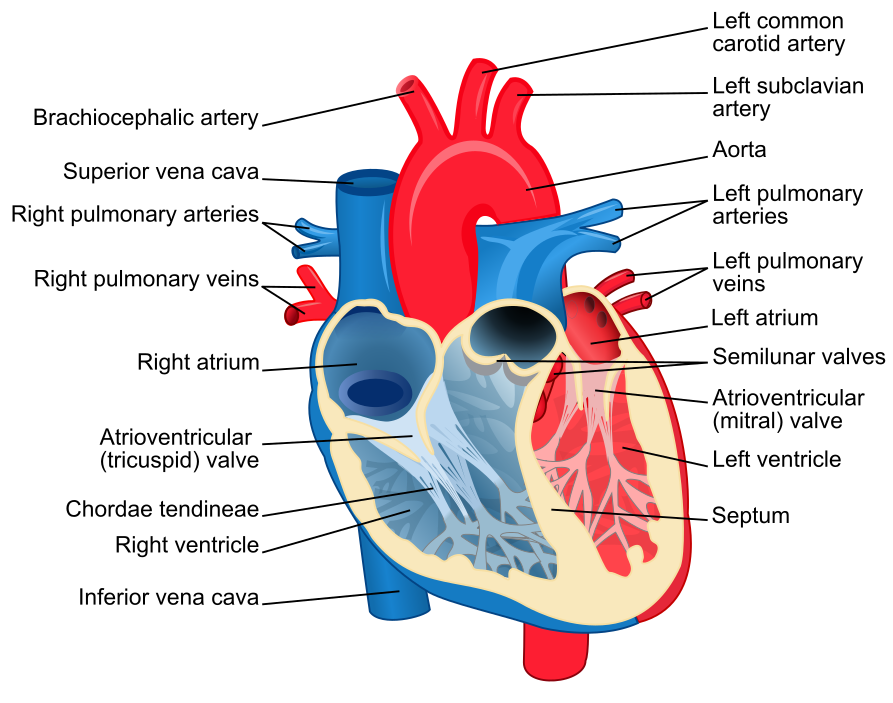
Heart diagram-en.svg · ZooFari · CC BY-SA 3.0
Original diagrams retained; the animation was converted from GIF to MP4.

Pulmonary, systemic and hepatic portal circulation
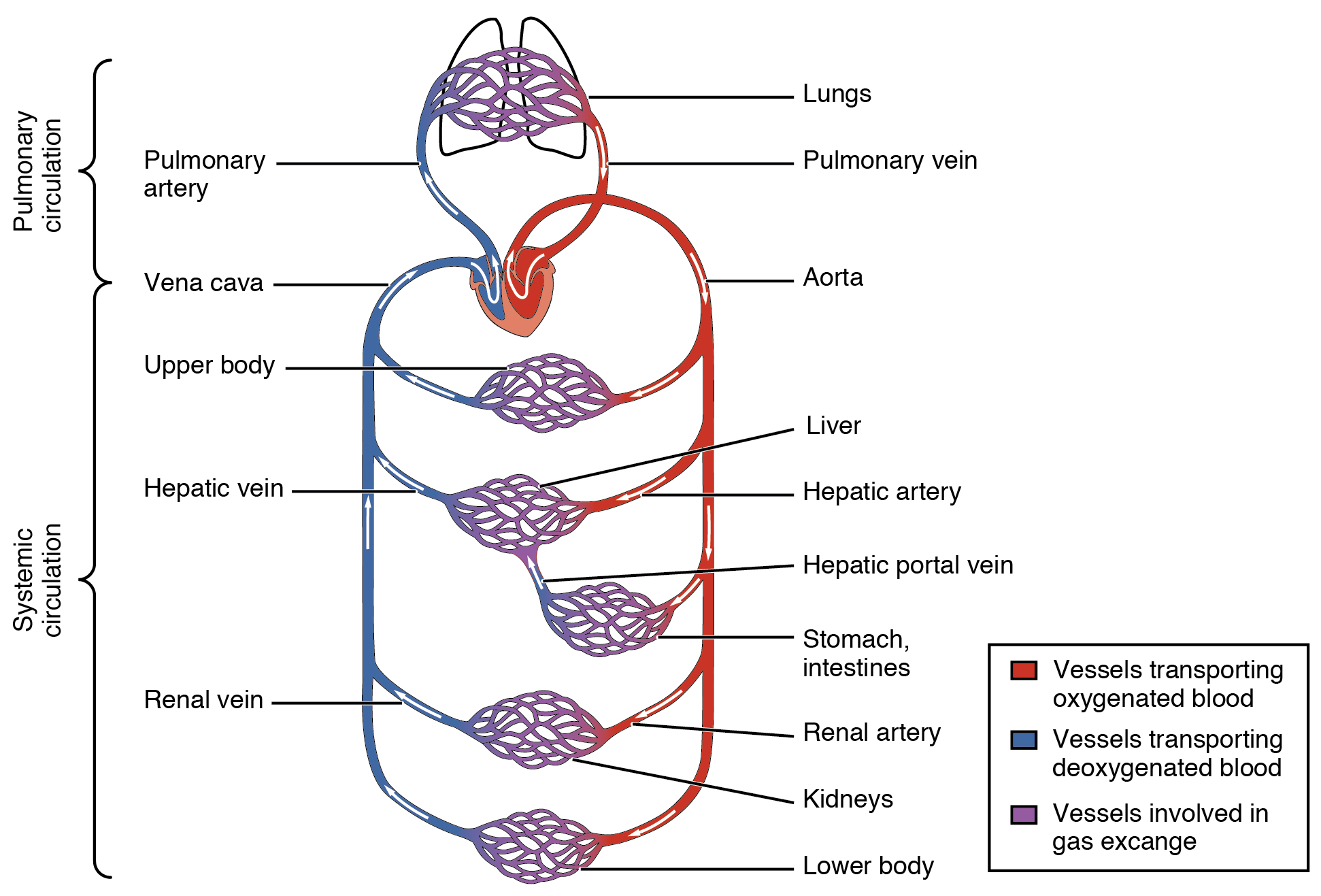
Pulmonary, systemic and hepatic portal circulation · OpenStax College · CC BY 3.0

| English label | Chinese equivalent |
|---|---|
| Pulmonary artery | 肺动脉 |
| Pulmonary vein | 肺静脉 |
| Aorta | 主动脉 |
| Vena cava | 腔静脉 |
| Hepatic portal vein | 肝门静脉 |
Change pressure and resistance
A steady-flow model in compatible arbitrary units: flow = (inlet pressure − outlet pressure) / resistance. A negative flow value indicates flow in the opposite direction. This does not model elasticity, pulsation, cellular oxygen supply or a clinical condition. Predict what raising only the outlet pressure will do.
How blood exchanges substances with tissues
Perfusion means blood passing through tissue. Oxygen usually diffuses from capillary blood toward cells, while carbon dioxide moves down its own partial-pressure gradient in the opposite direction. Exchange depends on surface area, distance and the driving gradient. Swelling can lengthen diffusion distances. Thus, blood moving through a large artery does not prove that microvascular exchange or cellular oxygen use is adequate.
Water movement also depends on hydrostatic pressure, protein-related oncotic effects and barrier permeability. The familiar picture of filtration at the arterial end followed by complete reabsorption at the venous end is too simple. In most tissues at steady state, lymphatic drainage is essential for returning filtered fluid and proteins. Oedema may reflect raised venous pressure, reduced plasma protein, a damaged barrier or impaired lymph drainage. Appearance alone cannot distinguish these mechanisms. Interstitial fluid sits between circulating blood and most cells and is an essential link in the exchange pathway.
OpenStax: capillary exchange; Levick & Michel: Microvascular fluid exchange and the revised Starling principle
Regulation balances the whole body and each organ
Standing suddenly redistributes blood under gravity. Venous return may briefly decrease, reducing ventricular filling and stroke volume. Stretch-sensitive receptors in areas such as the carotid sinus and aortic arch signal these changes. Reflex adjustments in heart rate, contraction and vascular tone help preserve circulation, although compensation is not always sufficient to prevent light-headedness.
Local tissues also influence arterioles. Metabolic changes in working muscle and signals from the endothelium encourage greater delivery. The kidneys contribute over longer periods by adjusting salt and water excretion. Autoregulation describes an organ’s ability to buffer flow against pressure changes within a limited range; it does not mean independence from pressure. Mechanisms and operating ranges differ across organs, and severe underperfusion can defeat compensation. Always specify the timescale: neural responses over seconds and volume adjustments over hours or days address connected but distinct parts of the problem.
Why normal pressure may coexist with poor oxygen delivery
Imagine two people with similar upper-arm blood pressures, but one has substantially less haemoglobin. Even if their blood flows were identical, each litre could carry a different amount of oxygen. A third person might have a severely narrowed leg artery without a corresponding abnormality in the arm reading. Oxygen delivery depends on both regional flow and arterial oxygen content, and must be compared with the tissue’s current demand.
The mistaken claim that higher pressure always means stronger, healthier circulation ignores the burden of persistently elevated pressure. Conversely, a low reading requires context, symptoms and reliable measurement. This lesson uses no invented calculation as a diagnostic threshold. A useful reasoning sequence is to identify what was actually measured, locate it within the causal chain, and list the remaining unobserved links. Pressure, flow, oxygen content and cellular demand answer different questions about the same circulation.
Use conditional reasoning instead of isolated numbers
In an invented organ model, let inlet pressure be 90, outlet pressure 10 and resistance 20, using compatible arbitrary units. Flow is 4. If inlet pressure rises to 110 while resistance rises to 25, the pressure difference becomes 100 and flow remains 4. If outlet pressure instead rises to 30 with the original inlet pressure and resistance, flow falls to 3. Each comparison is interpretable only after stating what remains constant.
Return to everyday examples. Swollen ankles after standing may involve venous pressure and filtration; greater muscle flow during exercise involves local resistance and cardiac output; fatigue with anaemia may involve oxygen-carrying capacity. The vague label “poor circulation” hides these different mechanisms. Draw a separate path from the proposed cause to flow, exchange and function. Then identify the evidence needed to distinguish that path from alternatives, rather than assigning one fixed cause to a nonspecific symptom.
Apply what you have learned
With unchanged pressure difference and half the resistance, what happens to model flow? Must cellular oxygen availability exactly double?
Read the explanation
Flow doubles. Cellular oxygen availability also depends on oxygen content, microvascular distribution, diffusion and demand. The calculation assumes steady conditions and otherwise unchanged inputs.
Bilingual terms
- 灌注 · Perfusion
- Passage of blood through tissue.
- 阻力 · Resistance
- Opposition to flow for a given pressure difference.
- 内皮 · Endothelium
- The cell layer lining blood vessels.
- 静水压 · Hydrostatic pressure
- Pressure exerted by fluid on surrounding surfaces.
- 自身调节 · Autoregulation
- Local mechanisms buffering flow within a limited pressure range.
Sources and further reading
- OpenStax: structure and function of blood vessels
- OpenStax: blood flow blood pressure and resistance
- OpenStax: capillary exchange
- OpenStax: homeostatic regulation of the vascular system
- Levick & Michel: Microvascular fluid exchange and the revised Starling principle
Original course source-check record: 9 September 2026. Full Chinese and English sentence-by-sentence language review: 14 September 2026. AI editing and language review are not human clinical review. Linked institutions have not participated in or endorsed this course.
A moment in nature

Emperor penguins in Antarctica.jpg · Dafna Ben nun · CC BY-SA 4.0
Converted to WebP; thumbnails may be cropped.
