LESSON 20 · Body structure and function
How bones, joints and muscles produce movement
Movement emerges from cooperation among bones, joints, muscles and nerves. Lifting a cup involves molecular contraction, torque, stability and feedback; muscle shortening is only one possibility.
What you will be able to do
- Connect bone and joint structure to support and motion.
- Explain sliding filaments, motor units and force regulation.
- Analyse everyday action using torque and contraction type.
In this lesson
Bone is living tissue undergoing remodellingJoints balance mobility and stabilitySliding filaments convert chemical energy into forceRecruitment and firing rate regulate forceThe same load can demand different joint torqueAdaptation requires loading, time and recoveryBilingual termsSourcesBone is living tissue undergoing remodelling
Bone contains an organic matrix, including collagen, and mineral components. The matrix contributes toughness while mineral contributes stiffness and load-bearing properties. Compact and trabecular bone organise material differently. Trabecular spaces are not functionless gaps; the arrangement of struts relates to local loading. Bone also contains vessels, nerves and marrow. It protects structures, helps regulate minerals and provides spaces for blood-cell production. OpenStax: bone structure
Osteoblasts help form matrix, osteoclasts resorb bone, and osteocytes sense and coordinate local conditions. Remodelling links removal of old tissue with formation of new tissue under mechanical, hormonal, nutritional and other influences. Bone density provides one dimension of information rather than all bone quality or fall risk. People with similar density may differ in architecture, strength and balance. Treating bone as an unchanging frame overlooks adult adaptation and repair and wrongly equates a stable short-term measurement with absence of biological activity. OpenStax: bone formation and development; OpenStax: exercise nutrition hormones and bone tissue
Joints balance mobility and stability
A joint is a connection between bones, and not every joint permits large movements like the knee. Synovial joints have a cavity enclosed by a capsule. Articular cartilage and synovial fluid reduce friction and help distribute loading. Ligaments usually connect bone to bone; tendons usually transmit muscle force to bone or another structure. Their related roles do not make the terms interchangeable. OpenStax: synovial joints
Stability depends on joint shape, capsules and ligaments, muscle activity and neural control. Greater range is not always better; excessive laxity without control can compromise stability. Stiffness likewise need not originate from one tissue. Normal articular cartilage contains no blood vessels, and its nutrition depends on local exchange conditions, contributing to limitations in repair. A joint sound alone cannot establish damage, and pain does not directly quantify cartilage loss. Evaluate structure, movement, loading and symptoms as related but distinct observations. OpenStax: synovial joints; IASP: Pain terminology
Force and length in three contractions
| Situation | Muscle state | Active tension? |
|---|---|---|
| Selected muscles while lifting | Shortening | Yes |
| Selected muscles while holding | Approximately constant length | Yes |
| Selected muscles during controlled lowering | Lengthening | Yes |
| Stretch without activation | Passive lengthening | Not active contraction |
Basic structure of a synovial joint
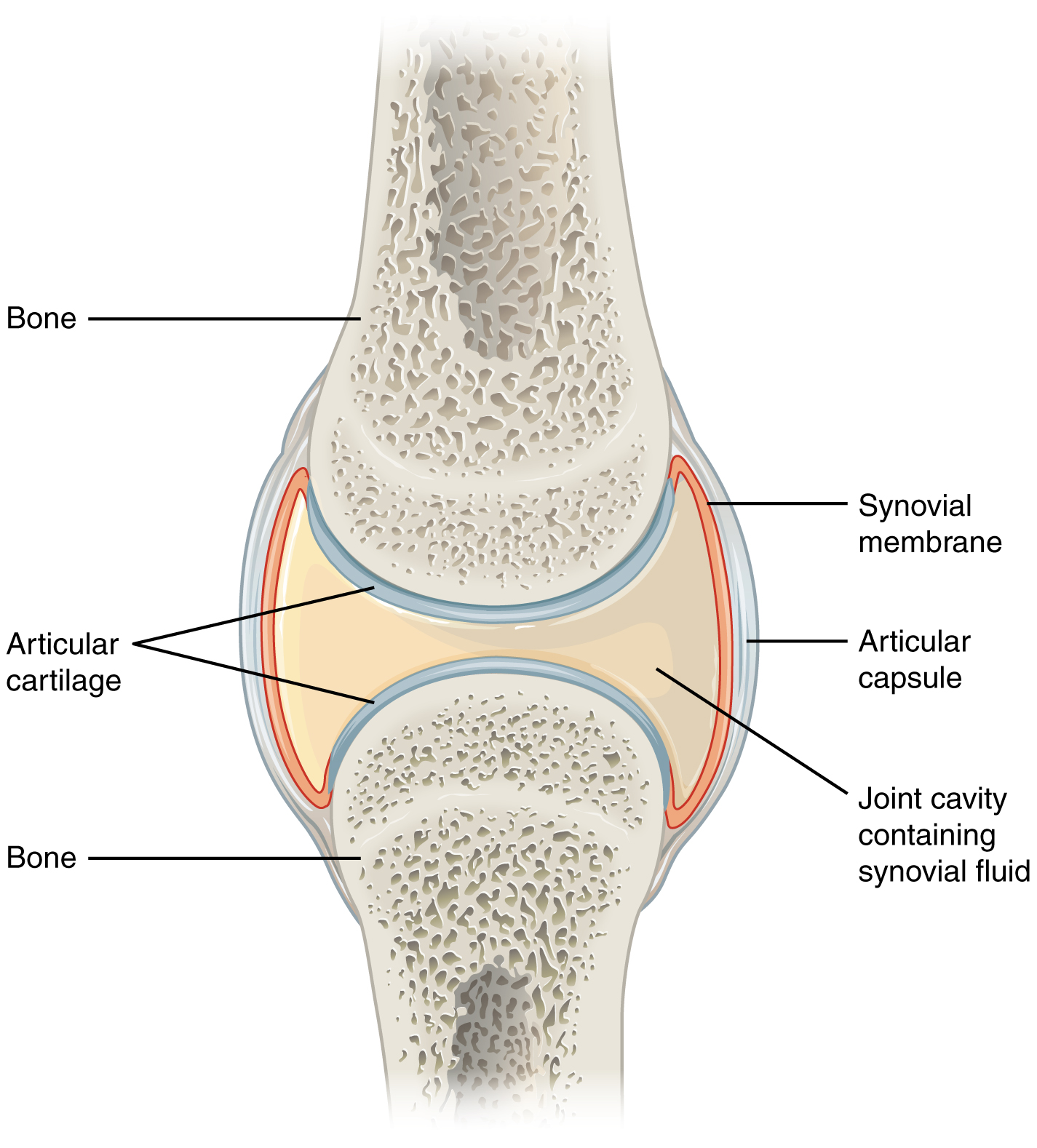
Basic structure of a synovial joint · OpenStax College · CC BY 3.0

| English label | Chinese equivalent |
|---|---|
| Bone | 骨 |
| Articular cartilage | 关节软骨 |
| Synovial membrane | 滑膜 |
| Articular capsule | 关节囊 |
| Synovial fluid | 滑液 |
Why is the same load harder to hold farther away?
Static equilibrium: external torque = force × perpendicular moment arm; muscle force × its moment arm balances this torque. Keep the load at 20 N and change only the external moment arm from 30 to 15 cm. The model omits arm weight, other muscles, acceleration and three-dimensional posture. It cannot determine safe lifting loads or injury risk.
Sliding filaments convert chemical energy into force
Skeletal muscle contains fibres with myofibrils organised into repeated sarcomeres. Actin and myosin interact through cross-bridge cycling to generate force. Filaments slide relative to one another rather than each filament becoming shorter. Signals at the neuromuscular junction initiate muscle-membrane electrical activity, leading to calcium release from the sarcoplasmic reticulum. Calcium changes regulatory-protein interactions and permits force generation. OpenStax: muscle fiber contraction and relaxation
ATP supports work but is also needed for cross-bridge detachment and calcium recovery, so relaxation requires energy. Defining contraction only as shortening cannot explain holding a shopping bag still. Physiologically, contraction refers to active tension generation: muscle may shorten, remain approximately the same length or lengthen while resisting an external force. Force depends on activation, length, shortening velocity and structure. Intact molecular machinery alone cannot guarantee performance against any load. Connecting molecular events to mechanical conditions turns terminology into an explanation of actual movement. OpenStax: muscle fiber contraction and relaxation; OpenStax: nervous system control of muscle tension
Recruitment and firing rate regulate force
A motor unit consists of one motor neuron and the muscle fibres it innervates. Units supporting fine control and those supporting larger force can differ in organisation and function. The nervous system adjusts total tension by recruiting additional units and changing firing frequency, among other mechanisms. Graded whole-muscle force is therefore compatible with all-or-none action potentials in individual excitable membranes. OpenStax: nervous system control of muscle tension
Fibres differ in contractile and metabolic properties, including fatigue resistance and rapid force production. These differences do not permanently restrict a person to one kind of activity. Fatigue is also not simply the accumulation of one waste product; neural drive, energy supply, ionic conditions and task demands contribute. Improved performance with practice can initially include coordination changes, with structural adaptation also developing over time. A short-term improvement does not prove large muscle growth. Technique, familiarity, sleep and measurement conditions should be considered before assigning every difference to tissue change. OpenStax: types of muscle fibers; OpenStax: exercise and muscle performance
The same load can demand different joint torque
Torque describes a force’s turning effect around an axis. In a simplified static model, it equals force multiplied by the perpendicular moment arm. Holding the same object farther from the elbow generally increases external torque, requiring a larger opposing muscular torque to maintain position. Muscle attachments often have short moment arms, so muscle force can greatly exceed the object’s weight. The weight alone is not the tendon load. OpenStax: interactions of skeletal muscles their fascicle arrangement and their lever systems
Agonist, antagonist and synergist are roles within a particular action, not permanent identities. Co-contraction can improve stability while changing internal joint loading. During lifting, selected muscles shorten; during holding they may remain approximately isometric; during controlled lowering they may generate force while lengthening. This last condition is eccentric contraction, not inactivity. Identify external force, axis, moment arm and motion direction together. An object moving downward does not prove muscle relaxation, and a simple diagram cannot calculate every real tissue load. OpenStax: muscle fiber contraction and relaxation; OpenStax: interactions of skeletal muscles their fascicle arrangement and their lever systems
Adaptation requires loading, time and recovery
Mechanical loading provides adaptive signals to bone, muscle and tendon, but tissues differ in response speed and current capacity. Too little loading may fail to provide maintenance signals, while overly rapid increases can exceed present tolerance. Pain, fatigue and tissue injury are not in one-to-one correspondence. Neither treating every discomfort as injury nor interpreting persistent worsening as proof of effectiveness is justified. Individual exercise prescriptions require context; this lesson supplies an analytical framework. OpenStax: exercise and muscle performance; IASP: Pain terminology; OpenStax: exercise nutrition hormones and bone tissue
Compare someone carrying a load close to the body with someone holding the same load at arm’s length. Consider moment arms and posture before strength, coordination and duration. Equal object weight does not mean an equal task. The simplified model omits acceleration, three-dimensional motion and tissue deformation. Stating these limits makes it useful for explaining greater effort without pretending to predict injury independently. Functional movement combines tissue structure, neural control, energy supply and environment rather than reducing to muscle size or one strength value. OpenStax: interactions of skeletal muscles their fascicle arrangement and their lever systems
Apply what you have learned
Must elbow flexors stop contracting while slowly lowering a cup? Why can a longer moment arm increase effort?
Read the explanation
No. Flexors can contract eccentrically to control descent. With other conditions unchanged, a longer external moment arm increases torque and requires greater opposing torque. Posture and dynamics also affect actual loading.
Bilingual terms
- 重塑 · Remodelling
- Coordinated renewal through bone resorption and formation.
- 肌节 · Sarcomere
- A repeated basic contractile unit in a myofibril.
- 运动单位 · Motor unit
- One motor neuron and the muscle fibres it innervates.
- 力矩 · Torque
- The turning effect of force around an axis.
- 离心收缩 · Eccentric contraction
- Active muscle tension while the muscle lengthens.
Sources and further reading
- OpenStax: bone structure
- OpenStax: synovial joints
- OpenStax: muscle fiber contraction and relaxation
- OpenStax: nervous system control of muscle tension
- OpenStax: interactions of skeletal muscles their fascicle arrangement and their lever systems
- OpenStax: bone formation and development
- OpenStax: types of muscle fibers
- OpenStax: exercise and muscle performance
- IASP: Pain terminology
- OpenStax: exercise nutrition hormones and bone tissue
Original course source-check record: 9 September 2026. Full Chinese and English sentence-by-sentence language review: 14 September 2026. AI editing and language review are not human clinical review. Linked institutions have not participated in or endorsed this course.
A moment in nature

Wildflower meadow, Gibson Street, Glasgow University.jpg · Rosser1954 · CC BY-SA 4.0
Converted to WebP; thumbnails may be cropped.
