
LESSON 19 · Body structure and function
Immunity and lymph: recognition, defence and tolerance
Immunity must respond to danger while limiting unnecessary injury. Lymphatic pathways connect fluid return, transport and encounters among immune cells, making defence organised and regulated.
What you will be able to do
- Connect lymphatic return with immune organisation.
- Distinguish innate recognition, adaptive responses and memory.
- Explain tolerance and the consequences of excessive responses.
In this lesson
Lymphatic pathways move fluid and immune informationInnate defence recognises recurring danger patternsAdaptive responses require selection and expansionAntibodies recognise targets but do not provide all defenceTolerance is regulated selective restraintCompare different mechanisms behind similar symptomsBilingual termsSourcesLymphatic pathways move fluid and immune information
Interstitial fluid is called lymph after it enters initial lymphatic vessels. It travels through larger vessels, lymph nodes and ducts before returning to venous circulation. Lymphatic return handles filtered fluid and proteins and transports part of the dietary lipid absorbed by the intestine. It is a structured pathway with specific cells and directions, not a route carrying vague “toxins” to a universal cleaner. OpenStax: anatomy of the lymphatic and immune systems
Lymph nodes organise encounters among antigens, antigen-presenting cells and lymphocytes. An antigen is a structure recognised by adaptive immune receptors, not a synonym for a pathogen. The spleen primarily surveys blood-related material, whereas nodes receive regional lymph; they are not interchangeable on a route map. Enlargement after infection can reflect cellular activity, but other causes exist. Size is not an immunity score. Understanding drainage links a local tissue event to nearby nodes while preserving uncertainty about the cause of swelling. OpenStax: anatomy of the lymphatic and immune systems; OpenStax: the adaptive immune response t lymphocytes and their functional types
Innate defence recognises recurring danger patterns
Skin and mucosa provide barriers, supported by mucus, cilia and local chemical conditions. If a barrier is breached or a pathogen enters, innate cells use pattern-recognition receptors to detect recurring microbial structures or damage-associated signals. Innate immunity is not devoid of recognition; its recognition strategy differs from the highly diversified receptors of adaptive immunity. OpenStax: barrier defenses and the innate immune response
Phagocytes ingest and process targets. Soluble systems including complement help mark pathogens, recruit phagocytes and directly damage the membranes of certain pathogens. Inflammation changes local vessels, cell movement and mediator release, supporting defence and repair while potentially causing pain, swelling and impaired function. Infection can trigger inflammation, but mechanical injury and other immune processes can do so without infection. Fever or redness cannot independently establish a bacterial cause or determine a need for antibacterial treatment. Separating the trigger from the host response explains why not every inflammatory event represents the same invading threat and why dysregulation itself can injure tissue. OpenStax: barrier defenses and the innate immune response
Immune observations and interpretive limits
| Observation | Does not independently establish |
|---|---|
| Redness and swelling | Infection is necessarily present |
| Normal white-cell count | Every defence function is normal |
| Positive antibody | Current active infection |
| Enlarged node | Greater immune competence |
Lymphatic system and immune organs
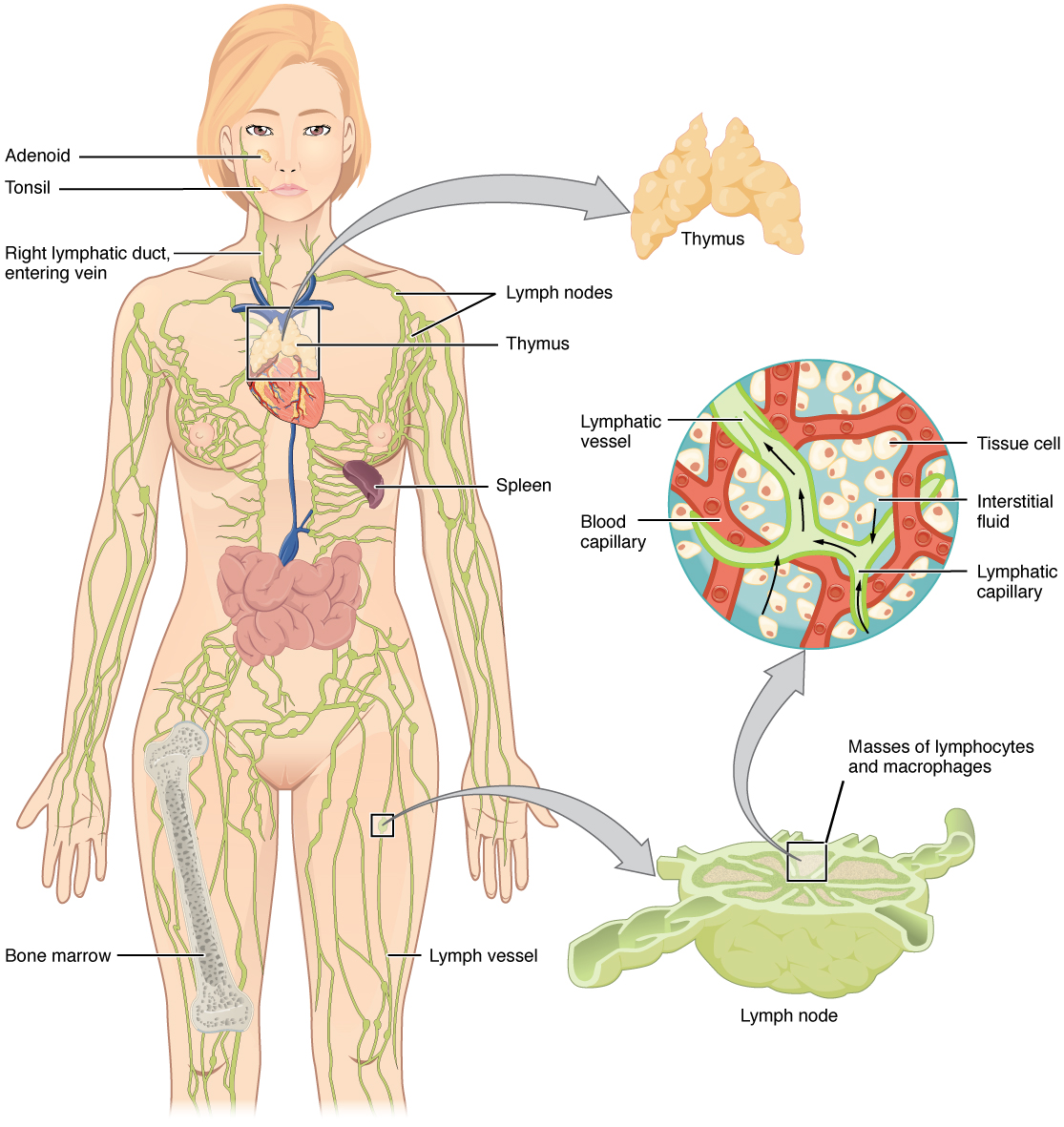
Lymphatic system and immune organs · OpenStax College · CC BY 3.0

| English label | Chinese equivalent |
|---|---|
| Lymph node | 淋巴结 |
| Lymph vessel | 淋巴管 |
| Thymus | 胸腺 |
| Spleen | 脾 |
| Bone marrow | 骨髓 |
| Interstitial fluid | 组织液 |
Adaptive responses require selection and expansion
Adaptive lymphocyte populations contain diverse receptors recognising different antigens. With appropriate signals, matching cells are selectively activated and expand, generating effectors and some memory cells. Clonal selection and expansion help explain why a first response takes time and why later exposure to the same antigen may produce a different speed and magnitude of response. OpenStax: the adaptive immune response t lymphocytes and their functional types
T cells commonly recognise antigen fragments presented by major histocompatibility complex molecules, together with relevant additional signals and context. Helper T cells coordinate other cells; cytotoxic T cells can recognise and act on selected abnormal target cells. Regulatory T cells and other mechanisms restrain inappropriate activity. Not every T cell is a direct killer, and receptor binding alone does not necessarily establish full activation. Innate antigen presentation and mediators shape adaptive responses. These are cooperating layers, not wholly separate teams that take turns only after the earlier team has failed. OpenStax: the adaptive immune response t lymphocytes and their functional types
Antibodies recognise targets but do not provide all defence
With suitable stimulation, B cells can differentiate into antibody-secreting plasma cells. Antibodies bind particular structures, helping neutralise toxins, block entry or mark targets for other mechanisms. Antibody classes differ in distribution and function; defence at mucosal surfaces is not identical to defence in blood. Antibodies do not always kill pathogens directly, and many effects require cooperation with other components. OpenStax: the adaptive immune response b lymphocytes and antibodies
Immune memory includes memory B and T cells as well as circulating antibodies and tissue responses. Falling antibody levels do not automatically mean all memory has disappeared. Conversely, detecting an antibody does not guarantee complete protection against every related infection. Vaccines use the capacity to learn particular antigens and reduce specific disease risks, with the degree and duration of protection influenced by the vaccine, pathogen and host. This is a mechanism lesson rather than a vaccination schedule. Interpret an antibody result by identifying its target and the evidence connecting that measurement with actual protection. OpenStax: the adaptive immune response b lymphocytes and antibodies; WHO: How do vaccines work?
Tolerance is regulated selective restraint
Immune tolerance is regulated avoidance of destructive responses to selected antigens, especially self components. Selection during lymphocyte development, together with peripheral inactivation, regulation and other controls, reduces self-reactivity. Tolerance does not switch off the entire system; it permits defence and tissue protection to coexist. Food and resident-microbial antigens also require context-dependent regulation involving barriers and local conditions. OpenStax: the adaptive immune response t lymphocytes and their functional types; OpenStax: diseases associated with depressed or overactive immune responses
Allergy involves inappropriate responses to ordinarily harmless substances; autoimmunity involves harmful responses against self. Immunodeficiency is another category. These cannot be placed on a single line from weak to strong immunity. A person can have inadequate protection in one domain and excessive inflammation in another. “Boost immunity” is difficult to evaluate without a specified target and outcome. Ask which defence is insufficient, which response is dysregulated and how function is assessed. This explains why suppressing selected immune pathways can improve health rather than requiring every response to become stronger. OpenStax: diseases associated with depressed or overactive immune responses
Compare different mechanisms behind similar symptoms
Imagine three people with local redness and swelling: one has a cut, another has allergen exposure, and the third has an infection. Shared vascular and inflammatory processes can produce similar appearances, while the initiating events differ. Inferring a pathogen from inflammation alone mistakes a host response for direct evidence of its cause. Conversely, absence of obvious fever does not establish absence of infection because timing, location and host conditions influence responses. OpenStax: barrier defenses and the innate immune response; OpenStax: diseases associated with depressed or overactive immune responses
Another exercise proposes adding total white-cell count to an antibody measurement to create an immunity score. The sum has no coherent physiological unit or validation and cannot represent barriers, phagocytosis, T cells, tolerance and memory. Start with the function of interest, then choose observations relevant to it. Appropriate recognition, effective clearance, tissue protection and timely resolution matter more than maximising every number. The goal is to ask testable questions about immune claims and identify the regulatory components they omit. OpenStax: anatomy of the lymphatic and immune systems; OpenStax: the adaptive immune response t lymphocytes and their functional types; OpenStax: the adaptive immune response b lymphocytes and antibodies
Apply what you have learned
Do an enlarged lymph node and a positive antibody test prove a current active infection with the same agent?
Read the explanation
No. Node enlargement has several causes, and antibodies may reflect past exposure or other contexts. Antibody type, timing, symptoms and evidence of a current agent are needed.
Bilingual terms
- 抗原 · Antigen
- A structure recognised by adaptive immune receptors.
- 先天免疫 · Innate immunity
- Defence using barriers and pre-existing recognition mechanisms.
- 适应性免疫 · Adaptive immunity
- Responses using diverse specific receptors and supporting memory.
- 免疫耐受 · Immune tolerance
- Regulated avoidance of destructive responses to selected antigens.
- 浆细胞 · Plasma cell
- A differentiated B cell secreting antibodies.
Sources and further reading
- OpenStax: anatomy of the lymphatic and immune systems
- OpenStax: barrier defenses and the innate immune response
- OpenStax: the adaptive immune response t lymphocytes and their functional types
- OpenStax: the adaptive immune response b lymphocytes and antibodies
- OpenStax: diseases associated with depressed or overactive immune responses
- WHO: How do vaccines work?
Original course source-check record: 9 September 2026. Full Chinese and English sentence-by-sentence language review: 14 September 2026. AI editing and language review are not human clinical review. Linked institutions have not participated in or endorsed this course.
A moment in nature

Puffin Flying by Flowers.jpg · Eric Kilby · CC BY-SA 2.0
Converted to WebP; thumbnails may be cropped.
