
LESSON 18 · Body structure and function
Hormones, endocrine systems and feedback
Hormones carry information through body fluids, but responses require suitable receptors and cellular conditions. Endocrine reasoning connects signal sources, receptors, feedback and timing.
What you will be able to do
- Compare hormone classes and cellular responses.
- Explain endocrine axes using negative feedback.
- Analyse concentration, receptor response and sampling time.
In this lesson
Endocrine signalling requires recognitionHow different hormone classes produce effectsNegative feedback creates a regulated axisInsulin and glucagon coordinate fuel movementPulses, rhythms and clearance shape a readingUse paired levels to develop testable explanationsBilingual termsSourcesEndocrine signalling requires recognition
Endocrine cells release hormones into the internal environment, allowing blood to carry them to distant sites. Exocrine secretion usually travels through a duct to an epithelial surface or lumen, as pancreatic digestive secretions enter the intestine. One organ can have both functions, so classification follows the particular pathway rather than the organ’s name. Local paracrine communication also exists; bodily signalling operates over several distances. OpenStax: an overview of the endocrine system
A target cell can respond because it has an appropriate receptor and downstream machinery. A hormone circulating in blood does not make every tissue respond identically. A broadcast analogy illustrates selective reception, but real cells can also alter receptor abundance with their state. Hormone concentration, sensitivity and cooperating signals jointly determine effects. Consequently, a “high hormone” result cannot be translated directly into one behaviour or universal health conclusion without considering the tissue and circumstances in which the signal acts. OpenStax: hormones
How different hormone classes produce effects
Many peptide hormones cannot freely cross the lipid membrane and mainly bind to surface receptors. Intracellular messengers then alter enzyme activity, transport or gene expression. Many steroid hormones interact with intracellular receptors and influence transcription and protein production. Thyroid hormones remind us that chemical origin and mechanism cannot be reduced to two perfectly simple categories. OpenStax: hormones; OpenStax: the thyroid gland
Surface-receptor effects can be rapid, whereas consequences requiring new gene expression often take longer, but hormones do not divide into universally fast and slow groups. Binding proteins, metabolic clearance and secretion rhythms also shape duration. Total hormone concentration differs from the free fraction. A change in binding proteins can alter the total without producing an equivalent change in biological action. Interpretation therefore requires knowing whether total or free hormone was measured, alongside method and reference range. A single “hormonal age” or balance score conceals conditions that determine the actual response. OpenStax: hormones; NIDDK: Thyroid tests
Different questions behind a concentration
| Stage | Question |
|---|---|
| Secretion | How much signal is produced? |
| Binding and distribution | How much can reach the target? |
| Receptors and signalling | Can the cell respond? |
| Clearance | How long does the signal persist? |
Locations of major endocrine glands
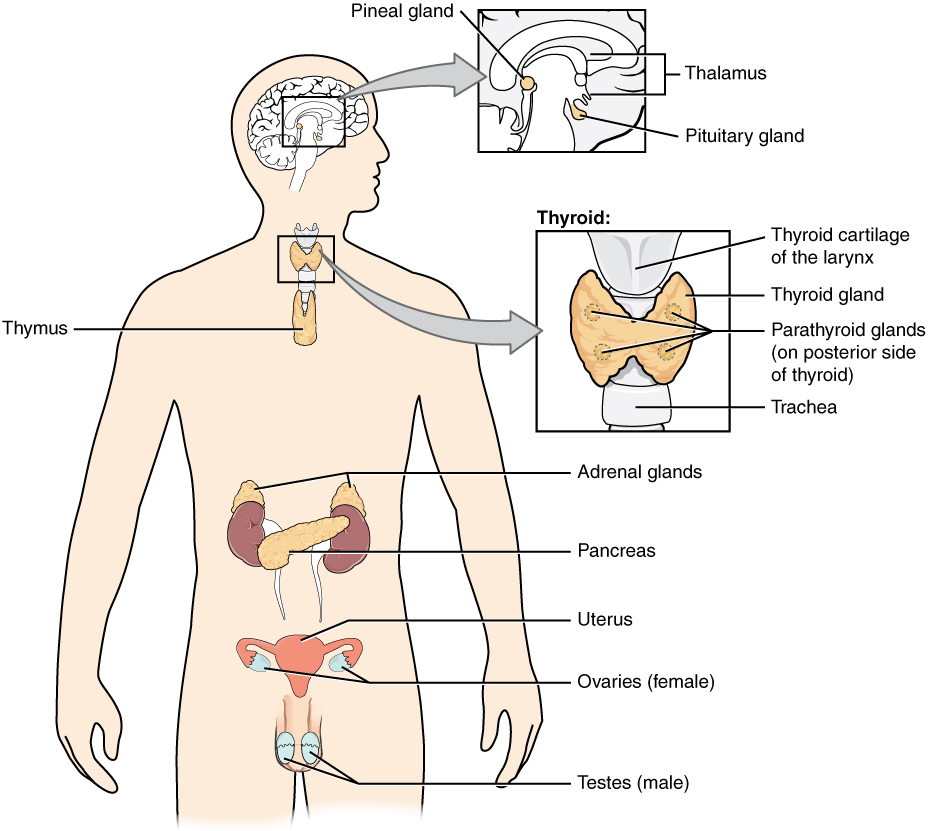
Locations of major endocrine glands · OpenStax College · CC BY 3.0

| English label | Chinese equivalent |
|---|---|
| Pituitary gland | 垂体 |
| Pineal gland | 松果体 |
| Thyroid gland | 甲状腺 |
| Parathyroid glands | 甲状旁腺 |
| Adrenal glands | 肾上腺 |
| Pancreas | 胰腺 |
| Ovaries | 卵巢 |
| Testes | 睾丸 |
Negative feedback creates a regulated axis
The hypothalamus, pituitary and selected peripheral glands form hierarchical axes. In the hypothalamic–pituitary–thyroid axis, upstream signals influence pituitary thyroid-stimulating hormone, which promotes thyroid activity. Thyroid hormones feed back on upstream structures. Negative feedback means that increasing output tends to restrain further stimulation; it does not require every concentration to remain permanently fixed. OpenStax: the pituitary gland and hypothalamus; OpenStax: the thyroid gland
The pituitary is not an independent commander detached from the brain and body. Sleep, circadian timing, nutrition, illness and feedback influence secretion. Antidiuretic hormone is synthesised in hypothalamic neurons and released from the posterior pituitary, unlike several hormones synthesised within the anterior pituitary. Distinguishing production from release preserves the anatomical mechanism. An axis model helps locate questions: low peripheral hormone with high upstream stimulation differs from both being low. However, measurement conditions and other influences remain relevant, so the diagram itself cannot establish a diagnosis. OpenStax: the pituitary gland and hypothalamus; NIDDK: Thyroid tests
Insulin and glucagon coordinate fuel movement
Pancreatic islet beta cells secrete insulin and alpha cells secrete glucagon. After eating, insulin helps selected tissues take up glucose and store nutrients and restrains some hepatic glucose-production processes. During fasting, signals including glucagon support hepatic glucose release. These hormones influence several metabolic pathways rather than acting as two simple buttons labelled lower and raise glucose. OpenStax: the endocrine pancreas
Not all cellular glucose uptake depends equally on insulin; tissues such as the brain and red cells have different transport characteristics. Insulin resistance describes a reduced tissue response under relevant conditions, not complete absence of insulin. Greater pancreatic secretion may initially compensate. Similar glucose concentrations can therefore coexist with different secretory loads and sensitivities. In a teaching scenario, one person requires more insulin to maintain the same glucose. Equal output does not establish equal physiological effort, but this comparison cannot independently determine a diagnosis or medicine dose. OpenStax: the endocrine pancreas; NIDDK: Insulin resistance and prediabetes
Pulses, rhythms and clearance shape a reading
Many hormones are released in pulses or circadian patterns rather than at a constant rate. Stressors, menstrual phase, meals, posture or medicines can affect particular measurements. A blood concentration combines secretion, distribution, binding and clearance. An increase does not always mean the gland has just secreted more; reduced clearance may contribute. One sample is a slice through a dynamic process. Endotext: Endocrine testing protocols, hypothalamic pituitary adrenal axis
Clinical testing sometimes uses standardised timing, repeated samples or stimulation and suppression procedures to evaluate adjustment, not simply a resting value. This lesson does not provide instructions for self-designed hormone challenges. Calling fatigue, weight change or low mood “endocrine imbalance” expresses a concern without identifying an axis, cause or evidence. A more informative record describes timing, context and the hypothesis being tested. Narrow the explanation as evidence supports a specific mechanism, rather than choosing a label first and searching for a number that appears to confirm it. NIDDK: Thyroid tests; Endotext: Endocrine testing protocols, hypothalamic pituitary adrenal axis
Use paired levels to develop testable explanations
In an invented feedback system, hormone A stimulates a gland to produce B, while B restrains A. Low B with high A suggests the hypothesis of an inadequate peripheral response, because upstream stimulation appears increased. Low A and low B raise the possibility of insufficient upstream stimulation. Medicines, acute illness, feedback delays and measurement error can also alter the pattern, so these are hypotheses rather than diagnoses. OpenStax: the thyroid gland; NIDDK: Thyroid tests; Endotext: Endocrine testing protocols, hypothalamic pituitary adrenal axis
In another scenario, high B produces little expected effect. Beyond measurement problems, consider binding, receptors and downstream signalling. Endocrine understanding asks not only whether a hormone exists but whether cells respond. State the model assumptions: intact feedback, applicable reference conditions and comparable sampling. Then identify which may fail in real life. A systems diagram organises evidence and generates useful next questions; it does not turn the body into a thermostat unaffected by time, tissue differences or circumstances. OpenStax: hormones
Apply what you have learned
In a negative-feedback axis, what does low peripheral hormone with high upstream stimulation suggest, and why is it not diagnostic?
Read the explanation
It suggests possible inadequate peripheral response. Medicines, acute illness, timing, assay conditions and feedback delays can violate the model assumptions.
Bilingual terms
- 激素 · Hormone
- A secreted chemical signal influencing target-cell activity.
- 受体 · Receptor
- A molecular structure recognising a signal and initiating a response.
- 负反馈 · Negative feedback
- Regulation in which output restrains its original drive.
- 靶细胞 · Target cell
- A cell with appropriate recognition and response machinery.
- 胰岛素抵抗 · Insulin resistance
- Reduced tissue responsiveness to insulin.
Sources and further reading
- OpenStax: an overview of the endocrine system
- OpenStax: hormones
- OpenStax: the pituitary gland and hypothalamus
- OpenStax: the endocrine pancreas
- OpenStax: the thyroid gland
- NIDDK: Thyroid tests
- Endotext: Endocrine testing protocols, hypothalamic pituitary adrenal axis
- NIDDK: Insulin resistance and prediabetes
Original course source-check record: 9 September 2026. Full Chinese and English sentence-by-sentence language review: 14 September 2026. AI editing and language review are not human clinical review. Linked institutions have not participated in or endorsed this course.
A moment in nature

Peacock butterfly (Aglais io) 2.jpg · Charles J. Sharp · CC BY-SA 3.0
Converted to WebP; thumbnails may be cropped.
_2.jpg)