
LESSON 17 · Body structure and function
The nervous system: sensing, signalling and control
The nervous system converts changes into signals and generates responses through networks. Understanding it requires separating electrical activity, chemical transmission, integration and behaviour.
What you will be able to do
- Distinguish central, peripheral, afferent and efferent pathways.
- Explain action potentials and synaptic integration.
- Analyse relationships among reflexes, voluntary control and sensation.
In this lesson
Start with pathways before memorising structuresNeurons depend on glia and their environmentAction-potential size is not stimulus intensityHow synapses transmit and integrate signalsMotor control includes feedback and predictionWhat symptoms can tell us about nervous system functionBilingual termsSourcesStart with pathways before memorising structures
The central nervous system comprises brain and spinal cord. The peripheral nervous system connects these structures with the rest of the body. Afferent pathways carry information toward the central system; efferent pathways carry commands toward effectors such as muscles and glands. These terms describe direction, not whether information comes only from skin or whether an output is consciously controlled. OpenStax: basic structure and function of the nervous system
When a hand touches something hot, sensory transduction, central integration, muscle contraction and the later conscious pain experience are connected but distinct events. Spinal circuits can organise a rapid withdrawal while signals continue upward for broader processing. This does not imply that the brain has no role in subsequent responses, nor that nervous activity begins only when pain becomes conscious. Following input, integration and output places movement and experience within one system while preserving differences in mechanism and timing. OpenStax: motor responses
Neurons depend on glia and their environment
Neurons commonly receive inputs through dendrites and the cell body and send signals along an axon, although their structures vary. Glial cells support metabolic conditions, myelin formation and immune-related functions; they are not merely passive packing. Different cells form myelin in central and peripheral systems. Myelin changes electrical conditions around an axon and supports rapid, efficient conduction. OpenStax: nervous tissue
Unequal ion distributions and selective membrane permeability allow cells to maintain membrane voltage. Pumps sustain concentration gradients over time, but moment-to-moment signalling mainly involves channels opening and closing, rather than a pump pushing one impulse down the entire nerve. Oxygen supply, energy availability and extracellular ion conditions therefore matter. Comparing a nerve to a wire captures only transmission. Living neurons consume energy, modify connections and respond to biochemical conditions, so a metal-wire analogy cannot explain every functional change or source of impairment. OpenStax: nervous tissue; OpenStax: the action potential
Connected but distinct neural stages
| Stage | Cup example |
|---|---|
| Sensory input | Detecting slip |
| Integration | Combining the goal with touch |
| Motor output | Adjusting finger-muscle activity |
| Prediction | Anticipating grip from experience |
Neuron and myelin
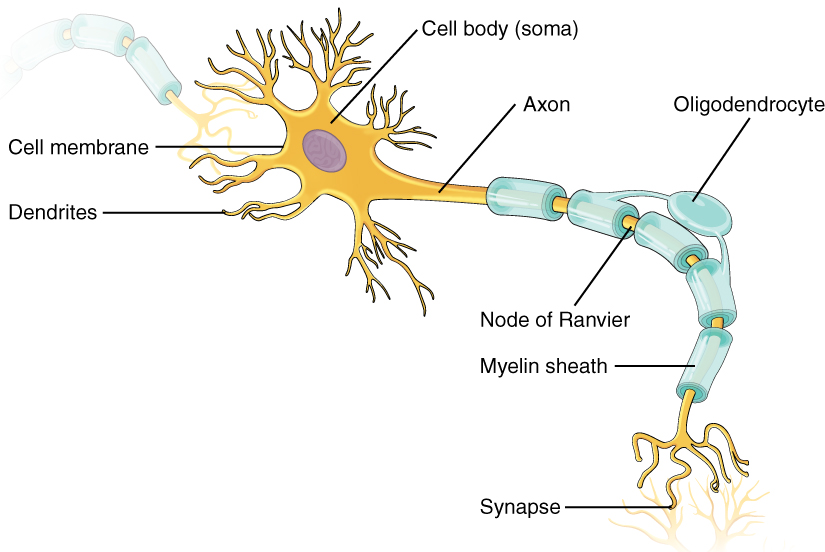
Neuron and myelin · OpenStax · CC BY 4.0

| English label | Chinese equivalent |
|---|---|
| Dendrites | 树突 |
| Cell body (soma) | 细胞体 |
| Axon | 轴突 |
| Myelin sheath | 髓鞘 |
| Node of Ranvier | 郎飞结 |
| Oligodendrocyte | 少突胶质细胞 |
| Synapse | 突触 |
Action-potential size is not stimulus intensity
Local inputs can produce graded changes in membrane potential. When the initiating region reaches an appropriate threshold, voltage-gated channel activity can generate an action potential: a brief, rapid voltage change. A typical axonal action potential is all-or-none. Stronger stimulation does not make every spike in that axon indefinitely larger. Information can instead be represented by firing frequency, timing and the population of recruited neurons. OpenStax: the action potential
During propagation, neighbouring membrane regions become activated in sequence. Nodes of Ranvier are especially important in myelinated axons. Channel inactivation and recovery create refractory periods, constraining repeated firing and supporting normal propagation characteristics. Conduction speed differs across fibres. A stronger touch may feel more intense because additional sensory units participate or their firing patterns change. Saying only that the electrical wave becomes larger incorrectly maps subjective intensity onto single-spike amplitude and omits the network level of coding. OpenStax: the action potential
How synapses transmit and integrate signals
At a chemical synapse, electrical activation of the axon terminal promotes calcium entry and vesicular release of neurotransmitter. Binding to receptors changes ion permeability or intracellular signalling, increasing or decreasing the likelihood of subsequent firing. Reuptake, breakdown or diffusion then removes transmitter. One arriving action potential does not necessarily produce one action potential in the receiving cell. OpenStax: communication between neurons
A neuron receives many inputs whose location, timing and strength jointly influence the result. Excitatory and inhibitory influences integrate across space and time. Inhibition is not a malfunction; it contributes to selection, stability and coordination. A transmitter’s effect depends on receptors and circuitry. Dopamine cannot simply be equated with pleasure, and a change in one transmitter cannot serve as the sole explanation for every psychological problem. Electrical synapses also exist. An explanation of neural activity needs to connect molecules, cells and networks; the presence of one molecule alone cannot explain complex behaviour. OpenStax: communication between neurons
Motor control includes feedback and prediction
Picking up a cup requires estimating its location, selecting an action, recruiting muscles and adjusting through touch and proprioception. Proprioception supplies information about limb position and movement from receptors associated with muscles, tendons and joints. Seeing a target is not enough for smooth manipulation without this feedback. Spinal cord, brainstem, cerebellum, basal ganglia and cerebral cortex contribute different aspects rather than assigning the entire movement to one isolated centre. OpenStax: motor responses
Autonomic pathways regulate cardiovascular, digestive and glandular activity. Sympathetic and parasympathetic effects depend on the organ; they are not universal switches with one always on and the other off. Voluntary action and autonomic adjustment often occur together. When a cup becomes slippery, analyse sensory input, circuit integration and altered grip output. Better performance may also use prediction before an error occurs, helping explain why experience can improve fluency rather than merely accelerate correction after failure. OpenStax: motor responses; OpenStax: divisions of the autonomic nervous system
What symptoms can tell us about nervous system function
One person may retain touch sensation yet struggle with fine finger movement, while another retains strength but has difficulty judging finger position. These patterns direct attention to different input or output components, but a brief description cannot identify a particular nerve or establish a diagnosis. Sensation, movement and integration can change separately or together because of a shared upstream problem. Distribution, onset and other observations are essential. OpenStax: basic structure and function of the nervous system; OpenStax: motor responses
Neural plasticity is the capacity for activity and experience to alter function or connections. It supports learning and aspects of recovery, but does not mean every injury can be fully reversed through effort. It also provides no basis for the claim that people use only a tenth of the brain. Ask whether an observation concerns sensation, action or interpretation; identify the level of the proposed mechanism; and consider alternative paths to the same outcome. Stating uncertainty prevents overextension of local evidence. StatPearls: Neuroplasticity; Association for Psychological Science: The ten percent brain myth
Apply what you have learned
Does stronger stimulation necessarily increase spike height in the same axon? Give two other coding mechanisms.
Read the explanation
No. Typical action potentials are all-or-none. Changes can be represented by firing frequency or timing and by recruitment of additional neurons.
Bilingual terms
- 传入 · Afferent
- Information travelling toward the central nervous system.
- 传出 · Efferent
- Commands travelling from the central system toward effectors.
- 动作电位 · Action potential
- A brief voltage change propagated along excitable membrane.
- 突触 · Synapse
- A junction transmitting neural information between cells.
- 本体感觉 · Proprioception
- Sensory information about body position and movement.
Sources and further reading
- OpenStax: basic structure and function of the nervous system
- OpenStax: nervous tissue
- OpenStax: the action potential
- OpenStax: communication between neurons
- OpenStax: motor responses
- OpenStax: divisions of the autonomic nervous system
- StatPearls: Neuroplasticity
- Association for Psychological Science: The ten percent brain myth
Original course source-check record: 9 September 2026. Full Chinese and English sentence-by-sentence language review: 14 September 2026. AI editing and language review are not human clinical review. Linked institutions have not participated in or endorsed this course.
A moment in nature

Zygopetalum 'Dunkle Blüte'.jpg · Petar Milošević · CC BY-SA 4.0
Converted to WebP; thumbnails may be cropped.
