
LESSON 16 · Body structure and function
The kidneys: urine, fluid balance and acid–base regulation
The kidneys generate filtrate, then selectively reclaim and secrete substances. Final urine reflects a sequence of regulated processes rather than blood passing through a single sieve.
What you will be able to do
- Trace substances through filtration, reabsorption and secretion.
- Explain distinct roles in water, salt and acid–base regulation.
- Distinguish urine output from glomerular filtration.
In this lesson
From kidney anatomy to the nephronFiltration creates fluid for further processingThree processes determine final excretionWater conservation and sodium retention are distinctKidneys and lungs jointly regulate acid–base conditionsUse a material balance to interpret urineBilingual termsSourcesFrom kidney anatomy to the nephron
The kidney has an outer cortex and an inner medulla. Formed urine passes through the collecting system into the renal pelvis and then through a ureter to the bladder. The bladder stores urine rather than producing it. Blood follows a separate route through renal arterial branches, the microcirculation and veins; diagrams should not merge these pathways. OpenStax: gross anatomy of the kidney
The nephron is the basic functional structure for filtration and tubular processing. It includes a renal corpuscle and tubule. Within the corpuscle, a capillary tuft called the glomerulus delivers filtrate into the surrounding capsule. Fluid then traverses the proximal tubule, nephron loop and distal tubule before entering collecting ducts. Different segments have different transport and permeability properties. This division permits conservation of essential substances alongside adjustment of excretion. Calling the kidney only a filter omits the processing that allows urine concentration to change after drinking, sweating or eating. OpenStax: microscopic anatomy of the kidney
Filtration creates fluid for further processing
Glomerular filtration moves plasma water and selected small solutes across a barrier into the glomerular capsule. Blood cells and most plasma proteins normally remain in circulation. Filtrate is therefore not simply a colourless copy of whole blood. Capillary pressure, capsular pressure, protein-related osmotic effects and barrier properties influence filtration. Renal blood flow and filtration rate are connected but are different quantities. OpenStax: physiology of urine formation
Glomerular filtration rate describes filtrate volume produced per unit time. Much of that fluid is subsequently reabsorbed, so final daily urine volume is far smaller. Producing substantial urine does not prove normal filtration; changes in output may instead reflect water regulation. Creatinine-based estimates also depend on production and factors such as muscle mass. They do not directly count functioning nephrons, and a single change cannot establish chronic disease. Naming the measured or estimated stage prevents “still passing urine” from becoming unjustified reassurance about the entire kidney. NIDDK: Quick reference on UACR and GFR
An accounting view of excretion
| Process | Direction of effect on excretion |
|---|---|
| More filtration, otherwise unchanged | Increase |
| More reabsorption, otherwise unchanged | Decrease |
| More secretion, otherwise unchanged | Increase |
| Only an increase in urine concentration is known | Total amount remains uncertain |
Nephron and surrounding blood vessels
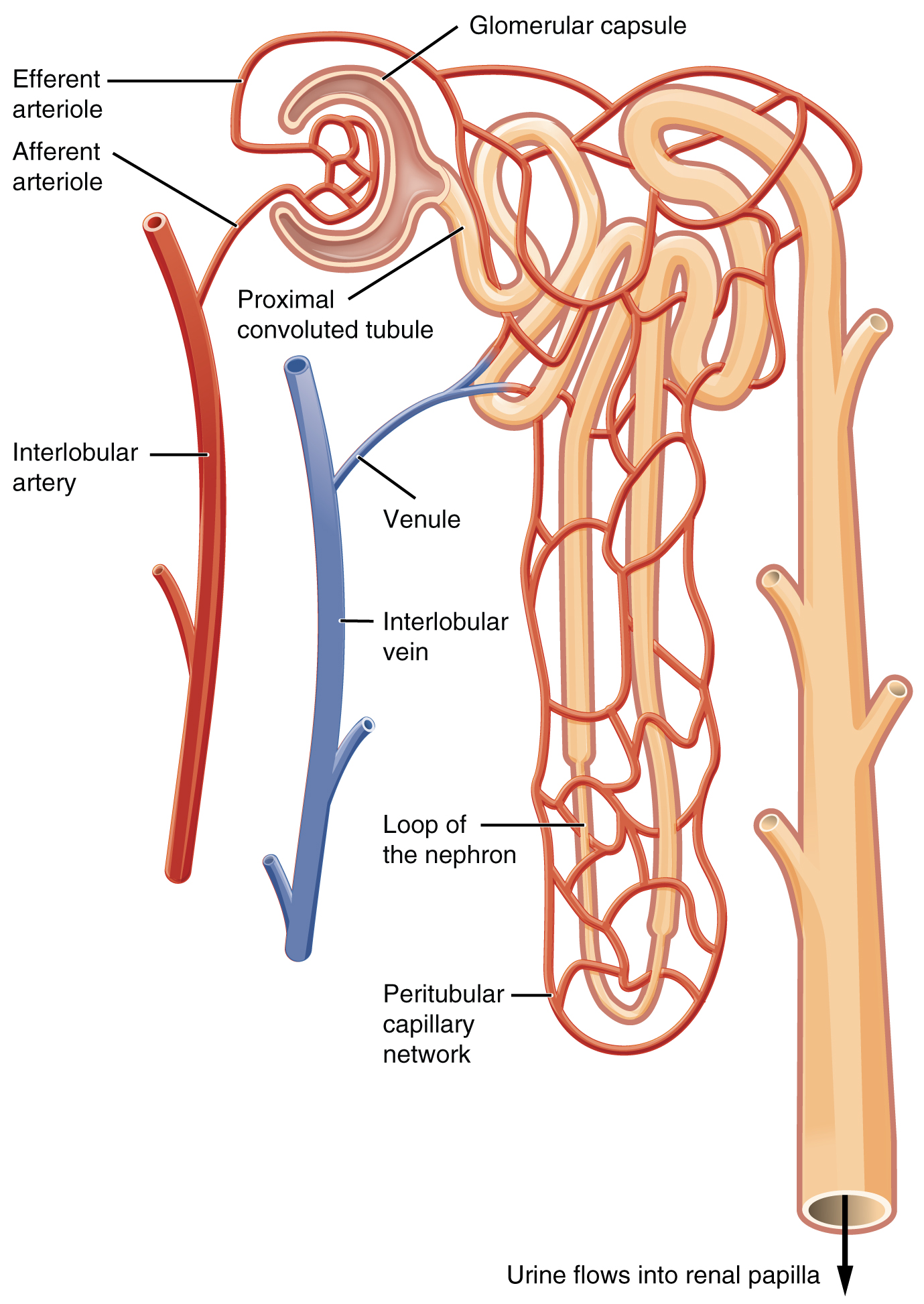
Nephron and surrounding blood vessels · OpenStax College · CC BY 3.0

| English label | Chinese equivalent |
|---|---|
| Afferent arteriole | 入球小动脉 |
| Efferent arteriole | 出球小动脉 |
| Glomerular capsule | 肾小囊 |
| Proximal convoluted tubule | 近曲小管 |
| Loop of the nephron | 肾单位袢(髓袢) |
| Peritubular capillary network | 小管周围毛细血管网 |
Account for a substance along the nephron
Use the same substance, time interval and arbitrary mass unit throughout. Assuming no production, breakdown or accumulation within the tubule: excretion = filtration − reabsorption + secretion. This explains mass balance, not actual kidney function or drug dosing.
Three processes determine final excretion
Reabsorption moves material from tubular fluid back toward blood. Secretion moves material from blood or tubular cells into the lumen. For a substance, a simplified accounting relation is: excretion equals filtration minus reabsorption plus secretion. These are amounts per unit time. Blood concentration, urine concentration and total excreted amount must not be treated as interchangeable measurements. OpenStax: physiology of urine formation
The proximal tubule reclaims substantial water and sodium and, under ordinary conditions, nearly all filtered glucose. Transport has a finite capacity. When the filtered load exceeds that capacity, more solute may remain in urine even without complete cellular failure. Later segments fine-tune salt, water and other constituents. Two urine samples with the same concentration but different volumes contain different amounts. Conversely, equal excretion can occur in different water volumes. This illustrates why colour or a spot concentration cannot replace complete functional interpretation, and why some assessments require explicit timing and total collection. OpenStax: tubular reabsorption
Water conservation and sodium retention are distinct
A medullary osmotic gradient, together with segment-specific permeability, allows the kidney to concentrate urine. Antidiuretic hormone, also called vasopressin, can increase collecting-duct water permeability, allowing greater reabsorption along an appropriate gradient. It neither creates water nor enables unlimited concentration when necessary structural conditions are absent. OpenStax: tubular reabsorption; OpenStax: endocrine regulation of kidney function
Total body sodium is closely related to extracellular fluid volume, whereas sodium concentration describes sodium relative to water. They are not interchangeable. The renin–angiotensin–aldosterone system supports sodium conservation and circulation under relevant conditions, and aldosterone also influences potassium handling. Someone sweating loses both water and salt. The resulting concentration depends on their relative losses, replacement and regulatory responses, so sweating alone cannot determine the direction of blood sodium change. Regulation has limits and takes time. Understanding these mechanisms does not yield one universal drinking or salt-replacement formula, particularly when diseases or medicines alter the system. OpenStax: endocrine regulation of kidney function; OpenStax: electrolyte balance
Kidneys and lungs jointly regulate acid–base conditions
Acid–base regulation tightly controls hydrogen-ion concentration. Chemical buffers rapidly reduce disturbances. The lungs adjust carbon dioxide elimination, while the kidneys reclaim filtered bicarbonate, generate new bicarbonate and excrete acid. Renal acid removal includes ammonium and titratable acids, so urine pH alone does not reveal the total acid excreted over a day. OpenStax: acid base balance; OpenStax: regulation of fluid volume and composition
For respiratory and metabolic disturbances, distinguish the primary process from compensation. Compensation is another system’s response; it does not remove the original cause and may not restore a normal pH. If carbon dioxide elimination remains altered, renal adjustment generally develops more slowly than respiratory responses, making timing relevant to test interpretation. The claim that a particular food makes the whole body beneficially “alkaline” ignores this coordinated regulation. A change in urine does not imply an equivalent change in blood. An organ-based model supports testable questions better than a vague label of acidic or alkaline constitution. OpenStax: acid base balance
Use a material balance to interpret urine
In an invented model, a substance is filtered at 100 units per minute, reabsorbed at 90 and secreted at 5. Excretion is 15. If reabsorption falls to 80 with everything else unchanged, excretion rises to 25. This requires neither an increased filtration rate nor greater drinking. Track the solute first and water separately, avoiding the assumption that more urine always means more of every substance is excreted. OpenStax: physiology of urine formation; OpenStax: tubular reabsorption
In clinical reasoning, glucose in urine may involve filtered load and transport; protein may involve the filtration barrier, reclamation and other sources; low output may involve circulation, filtration, reabsorption or obstruction. One observation can support several hypotheses. The kidneys also participate in erythropoietin and vitamin-D-related regulation. Their effects therefore extend beyond urination. State known variables, missing measurements and timing to understand why kidney dysfunction can involve oedema, blood pressure, anaemia and bone-mineral metabolism through different pathways. NIDDK: Your kidneys and how they work; NIDDK: Quick reference on UACR and GFR
Apply what you have learned
Does doubled urine output mean doubled filtration rate?
Read the explanation
Not necessarily. Tubular reabsorption and water regulation also determine final output. Filtration requires independent assessment; one downstream change does not identify a unique upstream cause.
Bilingual terms
- 肾单位 · Nephron
- The basic functional structure for filtration and tubular processing.
- 滤过 · Filtration
- Movement of water and selected solutes from plasma into the glomerular capsule.
- 重吸收 · Reabsorption
- Movement from tubular fluid back toward blood.
- 分泌 · Secretion
- Movement from blood or cells into tubular fluid.
- 代偿 · Compensation
- A regulatory response to a primary disturbance.
Sources and further reading
- OpenStax: gross anatomy of the kidney
- OpenStax: microscopic anatomy of the kidney
- OpenStax: physiology of urine formation
- OpenStax: acid base balance
- OpenStax: tubular reabsorption
- OpenStax: endocrine regulation of kidney function
- OpenStax: electrolyte balance
- NIDDK: Your kidneys and how they work
- NIDDK: Quick reference on UACR and GFR
- OpenStax: regulation of fluid volume and composition
Original course source-check record: 9 September 2026. Full Chinese and English sentence-by-sentence language review: 14 September 2026. AI editing and language review are not human clinical review. Linked institutions have not participated in or endorsed this course.
A moment in nature

Emperor penguins in Antarctica.jpg · Dafna Ben nun · CC BY-SA 4.0
Converted to WebP; thumbnails may be cropped.
