
LESSON 15 · Body structure and function
How the liver processes nutrients, drugs and metabolites
The liver processes nutrients, synthesises proteins, transforms foreign compounds and secretes bile. Calling it a detox organ obscures its regulatory functions and can misrepresent drug metabolism.
What you will be able to do
- Connect portal circulation with hepatocyte functions.
- Compare metabolism after meals and during fasting.
- Distinguish liver injury, synthesis and biotransformation.
In this lesson
Blood and bile follow different routesThe liver buffers fuel supply between mealsLipid processing includes transport and redistributionProtein synthesis and nitrogen handling are connectedDrug transformation does not always mean inactivationWhat different liver tests can tell usBilingual termsSourcesBlood and bile follow different routes
The liver receives blood from both the hepatic artery and portal vein. Portal blood drains digestive organs and related structures, bringing many newly absorbed water-soluble substances to the liver before they enter the wider circulation. Hepatocytes lie beside sinusoids, supporting exchange with passing blood. Bile instead enters tiny canaliculi between cells and then the biliary ducts; its route is not simply the route of venous blood.
Bile supports lipid handling and provides an excretory pathway for selected substances. The gallbladder mainly stores and concentrates it rather than producing it. Imagine a transport centre with one route delivering material for processing and another sending selected products into the intestinal lumen. Combining vessels and ducts into one line would obscure the distinction between impaired blood flow and biliary obstruction. Liver function also requires oxygen, viable cells and outflow, so one normal enzyme result cannot show that every pathway is functioning normally.
OpenStax: accessory organs in digestion the liver pancreas and gallbladder
The liver buffers fuel supply between meals
After a meal, incoming nutrients and signals including insulin favour use and storage. The liver can turn some glucose into glycogen and participate in converting surplus energy into lipid. During fasting, hepatic glycogen breakdown and gluconeogenesis help maintain blood glucose. Gluconeogenesis produces glucose from precursors such as lactate, glycerol and selected amino acids; it does not create energy from nothing and has its own energy cost.
The liver is one participant in a wider system. Muscle uses and stores fuel, adipose tissue stores or releases fatty acids, and the pancreas provides regulatory signals. The kidneys also contribute to gluconeogenesis, particularly with prolonged fasting. Liver and muscle glycogen serve different main purposes rather than forming a universally interchangeable store. A glucose concentration does not reveal the rates of production and utilisation behind it. Different fluxes can yield the same concentration, limiting conclusions from a single normal result.
Hepatic tasks and their different outputs
| Task | Product or consequence |
|---|---|
| Glucose storage | Glycogen formation |
| Nitrogen handling | Urea for renal excretion |
| Protein synthesis | Albumin and many coagulation proteins |
| Bile secretion | Supports lipid absorption and selected excretion |
Digestive anatomy
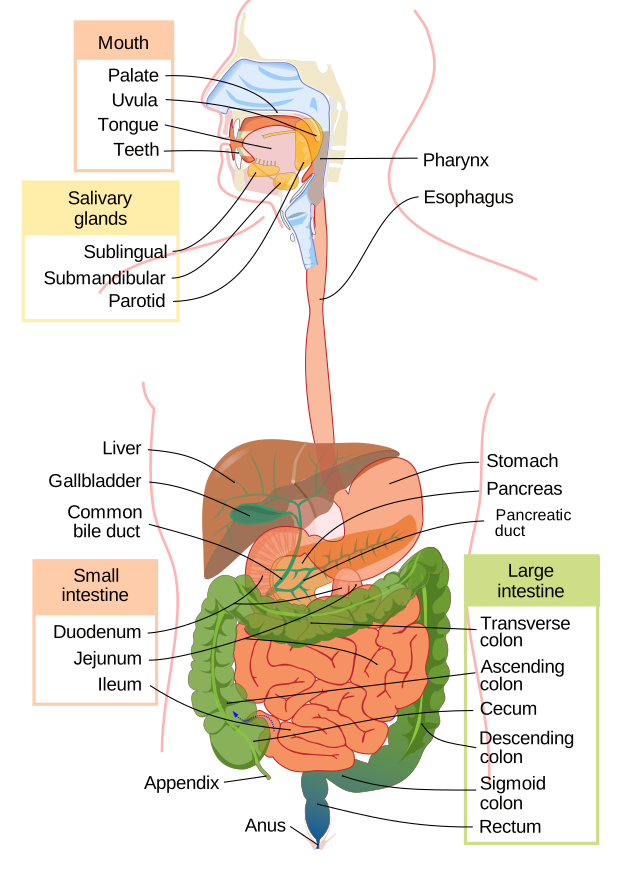
Digestive system diagram en.svg · Mariana Ruiz, Jmarchn · Public domain
Original diagrams retained; the animation was converted from GIF to MP4.


Pulmonary, systemic and hepatic portal circulation
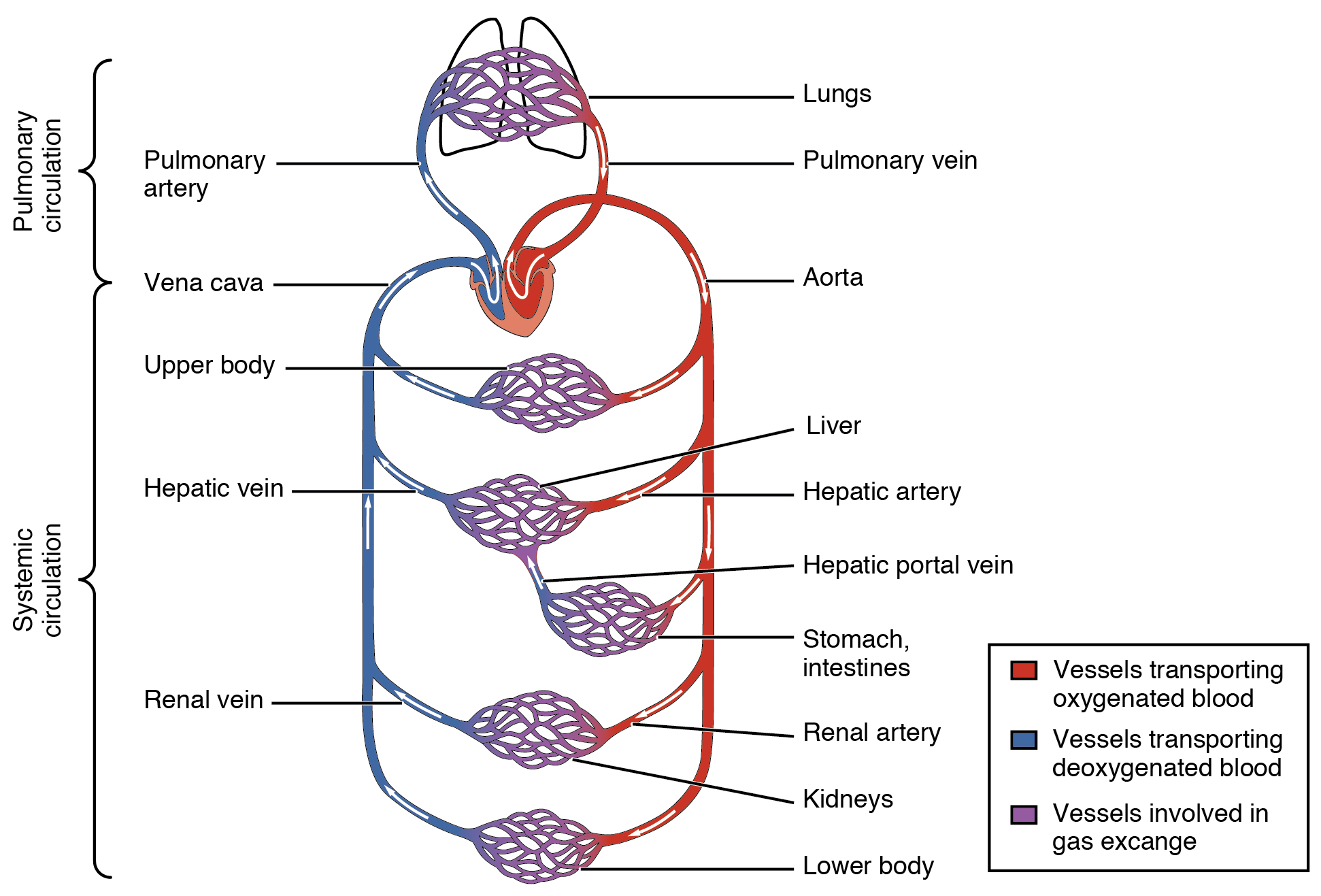
Pulmonary, systemic and hepatic portal circulation · OpenStax College · CC BY 3.0

| English label | Chinese equivalent |
|---|---|
| Pulmonary artery | 肺动脉 |
| Pulmonary vein | 肺静脉 |
| Aorta | 主动脉 |
| Vena cava | 腔静脉 |
| Hepatic portal vein | 肝门静脉 |
Lipid processing includes transport and redistribution
Fatty acids can be oxidised for energy or used to synthesise triglycerides and other compounds. The liver forms and processes lipoproteins, allowing water-insoluble lipids to travel in blood. Cholesterol contributes to membranes, bile acids and other physiological processes; it is not inherently useless waste. Both diet and internal synthesis contribute, and its level reflects several regulated inputs and outputs.
During conditions such as prolonged fasting, the liver can convert some fatty-acid-derived products into ketone bodies for use by other tissues. Physiological ketone production and dangerous acid–base disturbance are not interchangeable concepts, and a higher ketone value is not automatically better. Hepatic lipid accumulation likewise reflects the balance among delivery, synthesis, oxidation and export. Attributing it to a single mouthful of fat ignores long-term energy balance, metabolic conditions and individual context. A pathway-based explanation makes room for multiple mechanisms instead of assigning one universal dietary cause.
Protein synthesis and nitrogen handling are connected
The liver synthesises albumin and many coagulation-related proteins and participates in amino-acid conversion. The body has no dedicated store for excess protein. When excess amino acids are processed, their carbon skeletons can enter energy or synthetic pathways, while nitrogen requires appropriate disposal. Ammonia is potentially toxic. Through the urea cycle, the liver converts nitrogen into urea, which the kidneys predominantly excrete.
This is cooperation between organs: major transformation occurs in the liver and major excretion in the kidneys. Urea formation should not be assigned entirely to the kidney. Severe hepatic dysfunction can impair nitrogen handling, but a change in consciousness cannot be diagnosed from this mechanism alone. Low albumin also has several possible explanations, including altered synthesis, protein loss, inflammation and fluid distribution. Separate production, distribution volume and removal or loss. The measured concentration is the combined outcome of these processes, not a direct standalone verdict on one organ.
Drug transformation does not always mean inactivation
Hepatic enzymes alter the structure of medicines and other foreign compounds, sometimes making products more suitable for subsequent conjugation and elimination. Some medicines become less active, some require conversion to become active, and others can produce toxic metabolites. Faster metabolism is therefore not universally safer. Processing in the intestinal wall and liver before an oral drug reaches systemic circulation contributes to the first-pass effect and changes the amount that becomes available.
Enzyme activity can vary with genetics, disease, other medicines and selected food components, explaining how interactions change exposure. Drug handling is not exclusively hepatic: renal excretion and metabolism elsewhere also matter. A “liver detox” claim without a specified substance, dose, process and outcome lacks a testable meaning. Describing a product as natural does not establish absence of liver effects or interactions. These principles explain why drug-specific evidence is needed; they do not provide a method for adjusting doses according to subjective feelings.
FDA: Grapefruit Juice and Some Drugs Don’t Mix; FDA: Table of Pharmacogenetic Associations; OpenStax: Pharmacokinetics and Pharmacodynamics
What different liver tests can tell us
Liver-related tests do not form one universal function score. Some enzyme elevations suggest cellular injury or biliary processes, but their magnitude does not always track remaining functional capacity in a simple way. Bilirubin originates from haem breakdown and is processed by the liver before entering bile. Elevation may reflect increased production, altered uptake or processing, or impaired excretion. Coagulation-related tests and albumin provide other information, while also being influenced by nonhepatic factors.
Two people with similar aminotransferase values need not have the same cause, duration or functional reserve. Cirrhosis involves fibrosis and structural remodelling after chronic injury and can alter blood flow with wider consequences; an isolated abnormal result cannot establish it. Sort observations into questions about injury, processing and excretion, protein synthesis, and vascular structure. This preserves mechanistic depth while preventing the everyday phrase “liver function tests” from concealing the actual limits of each measurement.
MedlinePlus: Liver Function Tests; NIDDK: Definition and facts for cirrhosis
Apply what you have learned
A medicine requires hepatic conversion for activation. Does inhibiting that enzyme necessarily strengthen its effect?
Read the explanation
No. Activation may decrease and the effect may weaken. Parent-drug activity, alternative pathways and elimination also matter; slower metabolism does not universally mean a stronger effect.
Bilingual terms
- 门静脉 · Portal vein
- A vein delivering blood from digestive and related organs to the liver.
- 肝细胞 · Hepatocyte
- A cell performing most hepatic metabolic and synthetic functions.
- 糖异生 · Gluconeogenesis
- Glucose production from noncarbohydrate precursors.
- 尿素循环 · Urea cycle
- Reactions converting nitrogenous products into urea.
- 首过效应 · First-pass effect
- Presystemic processing of a drug in sites including gut wall and liver.
Sources and further reading
- OpenStax: accessory organs in digestion the liver pancreas and gallbladder
- OpenStax: carbohydrate metabolism
- OpenStax: lipid metabolism
- OpenStax: protein metabolism
- NIDDK: Definition and facts for cirrhosis
- FDA: Grapefruit Juice and Some Drugs Don’t Mix
- FDA: Table of Pharmacogenetic Associations
- MedlinePlus: Liver Function Tests
- OpenStax: Pharmacokinetics and Pharmacodynamics
Original course source-check record: 9 September 2026. Full Chinese and English sentence-by-sentence language review: 14 September 2026. AI editing and language review are not human clinical review. Linked institutions have not participated in or endorsed this course.
A moment in nature

Sunlight in the forest.jpg · Antoloji · CC BY-SA 4.0
Converted to WebP; thumbnails may be cropped.
