
LESSON 14 · Body structure and function
Digestion, absorption and elimination
Digestion involves movement, breakdown, membrane transport and regulation. Eating a nutrient does not mean it has already entered the blood or will be used immediately.
What you will be able to do
- Distinguish digestion, absorption and defecation.
- Trace major carbohydrate, protein and fat pathways.
- Consider different mechanisms that could explain a symptom, rather than assigning it a single label.
In this lesson
The gut converts external material into absorbable componentsPropulsion and mixing require different movementsEnzymes and bile perform different tasksAbsorbed nutrients follow different routesThe colon does more than store stoolPractise causal reasoning with lactoseBilingual termsSourcesThe gut converts external material into absorbable components
The gastrointestinal tract is a tube continuous with the outside environment. Material inside its lumen has not yet crossed the epithelial barrier. Digestion involves mechanical processing and chemical breakdown; absorption moves substances across epithelium into blood or lymph; defecation removes unabsorbed residues and other contents. Swallowing food therefore does not mean all its nutrients have entered the internal environment.
The mucosa provides barrier, secretory and absorptive functions. Muscle layers mix and propel contents, supported by nerves and blood vessels. The stomach stores and churns, the small intestine performs most nutrient digestion and absorption, and the large intestine further handles water, electrolytes and residues. This division is more accurate than attributing all digestion to the stomach. An upstream problem can change downstream conditions: incomplete breakdown delivers additional substrate to later segments. Symptoms appearing there do not necessarily identify the original site of the problem.
Propulsion and mixing require different movements
Peristalsis uses coordinated contractions to propel contents. Segmentation mainly mixes material, repeatedly exposing it to digestive secretions and absorptive surfaces. Sphincters help regulate passage between regions and limit reflux. Swallowing progresses from partly voluntary activity into coordinated reflexes; normal digestion does not require conscious direction of every contraction.
The enteric nervous system organises many local activities while receiving autonomic and hormonal influences. Distension, acidity and nutrients such as fat modify secretion and gastric emptying, helping match delivery to intestinal processing capacity. Equal volumes of water and a complex meal do not necessarily leave the stomach at the same rate, so volume alone cannot determine absorption timing. Anxiety-associated gut sensations need not be imaginary: neural regulation can change movement and perception. However, recognising this connection does not independently exclude other causes. A causal account requires the pattern of symptoms and additional evidence.
From food to the internal environment
| Stage | Example |
|---|---|
| Mechanical processing | Chewing and gastric mixing |
| Chemical digestion | Enzymatic molecular breakdown |
| Absorption | Monosaccharides cross intestinal cells |
| Transport | Portal blood or lymph carries products |
Digestive anatomy
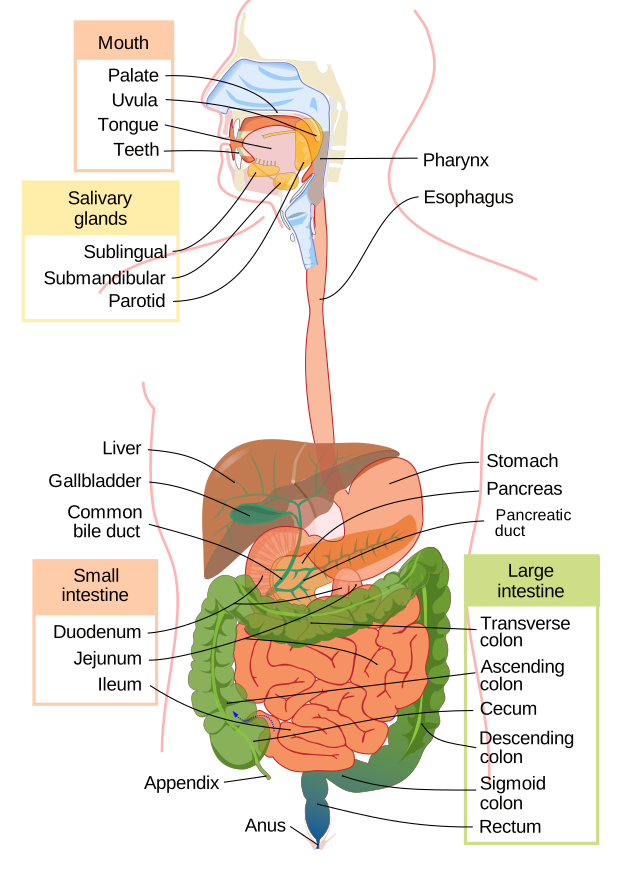
Digestive system diagram en.svg · Mariana Ruiz, Jmarchn · Public domain
Original diagrams retained; the animation was converted from GIF to MP4.


Observe peristalsis
Peristalsis · Auawise · CC BY-SA 4.0 · GIF → MP4

Further video: how the antral pump mixes and propels food (external video; regional access may vary)
Enzymes and bile perform different tasks
Enzymes catalyse particular reactions that break large molecules into units suitable for further processing or absorption. Amylases participate in starch breakdown, proteases cleave proteins, and lipases act on fats. Gastric acid helps alter protein structure and supports stomach enzyme activity. Pancreatic bicarbonate helps neutralise acidic contents entering the small intestine, creating conditions suitable for subsequent reactions. Greater acidity does not universally improve digestion.
The liver makes bile, and the gallbladder stores and concentrates part of it. Bile salts disperse fat and support structures that bring lipids toward intestinal cells. Bile is not a lipase and does not cleave fat molecules through the same mechanism. The pancreas has an exocrine route, sending digestive secretions through ducts, and an endocrine route, releasing hormones such as insulin internally. For impaired fat absorption, distinguish bile delivery, enzyme activity and epithelial transport rather than calling all three “poor stomach movement.”
OpenStax: accessory organs in digestion the liver pancreas and gallbladder
Absorbed nutrients follow different routes
Folds, villi and microvilli enlarge the small intestine’s absorptive surface, but area alone is insufficient without functioning transport mechanisms and blood supply. Most carbohydrates are absorbed as monosaccharides. Protein products enter intestinal cells as amino acids and small peptides before leaving in suitable forms. Different substances use different transport proteins and energy-coupling mechanisms; absorption is not passage through one indiscriminate sieve.
Many water-soluble nutrients reach the liver first through portal blood. Long-chain lipids are reassembled within intestinal cells and packaged into chylomicrons, which mainly enter lymph before reaching blood. Thus, not all absorbed food travels directly from intestinal blood vessels to the liver. Water follows osmotic relationships, and substantial water absorption occurs in the small intestine. Adequate intake and adequate absorption are separate questions. Nevertheless, one episode of bloating cannot establish malabsorption, because gas production, sensation and movement can also change the experience.
The colon does more than store stool
Material reaching the colon includes unabsorbed components, fluid, shed cells and microbes. The colon continues absorbing water and electrolytes. Microbes ferment selected residual carbohydrates, producing short-chain fatty acids and gases. The host can use some fermentation products, but microbial effects cannot be summarised as “more bacteria is always better.” Stool is also not simply an unchanged remainder of the previous day’s food.
Defecation requires colonic movement, rectal distension signals, sphincter and pelvic-floor coordination, and a suitable behavioural setting. Hard stool may involve water handling and transit time, but inadequate drinking cannot explain every case of constipation. Diarrhoea may involve secretion, impaired absorption, an osmotic load or altered movement; it is not evidence of beneficial “detoxification.” Frequency, consistency, duration and associated features together form the observation. Mechanistic categories help learners ask better questions, rather than diagnose themselves from one photograph or a single change in bowel habit.
Practise causal reasoning with lactose
Imagine an adult who repeatedly develops bloating and loose stool after milk. In some circumstances, insufficient lactase activity allows incompletely digested lactose to reach more distal bowel segments. Residual sugar can increase the luminal osmotic load, and microbial fermentation produces gas. Enzyme activity, substrate, osmosis and fermentation together provide a more specific explanation than saying milk is “hard to digest.”
However, similar symptoms can have other causes. Lactose intolerance and milk-protein allergy involve different mechanisms and should not be used as interchangeable labels. Dose, accompanying food and individual sensitivity influence the response, so one experience cannot justify a lifelong conclusion about every dairy product. Separate observations, the mechanism needing verification and competing explanations. Check that a problem digesting one substance has not become a claim that no nutrients are absorbed or that the entire gut has failed. Keeping conclusions proportionate is part of accurate health reasoning.
Apply what you have learned
Which processing steps are mainly affected by insufficient bile and insufficient lactase?
Read the explanation
Insufficient bile affects lipid dispersion and conditions for absorption; insufficient lactase affects lactose breakdown. Bile is not a digestive enzyme, so the two problems require different molecular explanations.
Bilingual terms
- 消化 · Digestion
- Mechanical processing and chemical breakdown of food.
- 吸收 · Absorption
- Movement across intestinal epithelium into the internal environment.
- 蠕动 · Peristalsis
- Coordinated contractions promoting forward movement.
- 胆盐 · Bile salts
- Bile components supporting lipid dispersion and absorption.
- 乳糜微粒 · Chylomicron
- A particle packaging dietary lipids in intestinal cells.
Sources and further reading
- OpenStax: overview of the digestive system
- OpenStax: digestive system processes and regulation
- OpenStax: accessory organs in digestion the liver pancreas and gallbladder
- OpenStax: chemical digestion and absorption a closer look
- OpenStax: the small and large intestines
- NIDDK: Symptoms & Causes of Lactose Intolerance
Original course source-check record: 9 September 2026. Full Chinese and English sentence-by-sentence language review: 14 September 2026. AI editing and language review are not human clinical review. Linked institutions have not participated in or endorsed this course.
A moment in nature
Mother Calf African Bush Elephant Kafue Jul23 A7C 05569.jpg · Timothy A. Gonsalves · CC BY-SA 4.0
Converted to WebP; thumbnails may be cropped.
